Editor’s Note: This is the fourth of four posts continuing where “Not Forever, Just for a While” left off. Previously: Asta Networks, AskMe, and the seven months off. This post: All Star Directories (my first consulting client), and the drive back to California.
I still don’t know what I want to be when I grow up.
That question lingered on in 2005, my last year in Seattle before returning to Silicon Valley. However, raising a family doesn’t leave infinite time for experimentation, and seven months off made me realize that it would be easier to build on what already came pretty naturally to me, rather than to pursue new patterns like running a photo kiosk business. All Star Directories, my first consulting client, was not a real answer to my long-term question, but it did help me see the path I should take in the short term.
I closed my last post with a phone call from an acquaintance, referring me to one of his friends looking for some contract help. That friend turned out to be the founder and CEO of a startup called All Star Directories. Before we had our first face-to-face meeting, he’d already done a bit of backdoor reference checking both with an old Microsoft colleague who happened to be one of AskMe’s founders, and his IT/Ops Manager, who happened to work with me there at AskMe.
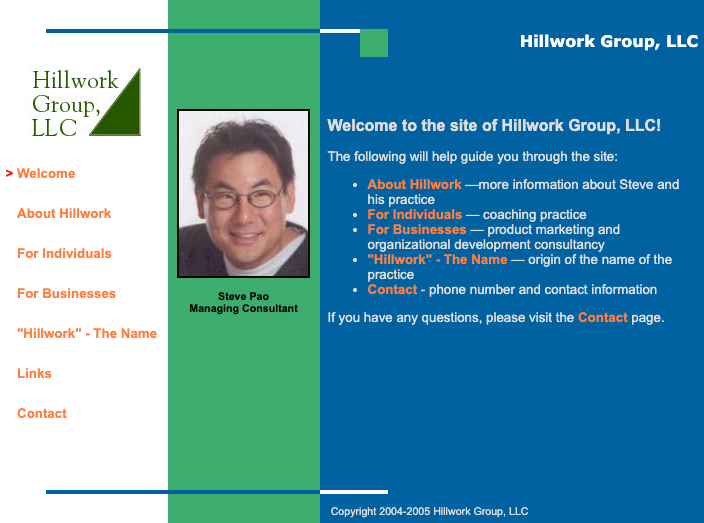
While I expected a more traditional interview, he basically told me what he was looking for, asked me if it sounded interesting, and presented me with a contract. So, without any sort of sales pitch at all,, All Star Directories became the first consulting client of Hillwork Group, LLC. (I later dropped “Group” from my company registrations when I realized I never wanted employees!)
The business
All Star Directories ran a set of web properties that cataloged schools by field of study, including nursing, allied health, culinary, and more. The sites featured their own editorial content, built from information in the public domain, as well as other information that the schools would provide to the company. Non-profit schools paid a small subscription fee to have prospective student inquiries routed to their admissions office. For-profit schools paid a fee for each lead.
My first assignment involved some basic inbound product management work. I gathered requirements from the editorial team servicing the schools and worked with engineering to match those requirements to what the platform could actually deliver.
An implicit promotion
Looking back, the CEO probably had a larger role in mind for me from early on. He kept handing me more to do, a little at a time, before he ever made anything official. It was just pretty natural, and the culture at All Star was already so open that taking on more never felt like any sort of leap. People started treating me as the head of the product organization before I remember there being any formal organizational change. I credit the team as a whole for this very organic collaboration.
Eventually it became explicit. I moved into an interim executive role responsible for the product organization. The business had three pillars. Sales recruited schools to pay for lead flow. Marketing generated the traffic of prospective students to the web properties. Product focused on the conversion of the student’s visit into a lead for the schools.
During the time I was there, the product team grew from eight people to more than thirty. The systems the product team served multiple audiences. For marketing, the systems provided the data needed to optimize paid and organic traffic. For sales, the systems delivered the leads and the reporting that the schools wanted. For the students, the sites matched them with the schools and content that actually fit them.
What actually made the difference
The real differentiator wasn’t something I invented. It was a discipline the team already had before I got there. The company was committed to delivering the highest quality leads to schools, not the highest volume, and none of it was ever gimmicky.
The aim was simply to provide high quality content and merchandising to serve students well and to encourage them to spend real time in the directory. With the high quality leads, the assertion was that schools would value All Star leads higher than their other sources. Achieving these goals most effectively, often had to translate into new product requirements, tough decisions to refactor or rebuild code, and ultimately to hire people.
The CEO
I really enjoyed working for the All Star founding CEO. He had already had success running MSN.com for Microsoft. He had also bounced a couple of times with less successful endeavors after leaving Microsoft. All Star was his next venture, this time built the way he wanted to build it after a number of hard lessons. He wasn’t interested in working people to the ground. He wanted to build something that would last. And he gave me real latitude to run different experiments, which kept the work interesting for both of us.
The ending
Private equity approached him, and it forced him to think through what was best for him and the company. He recruited a new CEO, a very nice guy, to run the company under the new owners. I probably would have liked staying, except the role would have meant reporting into private equity instead of into him, and I didn’t want that.
He didn’t just announce the sale and leave it there. He met with the whole management team together at an offsite at his own house, built around bringing everyone along and setting up a clean handoff to the new owners going forward.
My own role within the company at the same time was winding down the way we designed an interim function. We hired and promoted people into the functions I had been covering, and by the time the actual handoff happened, I was already working on special projects. Part of why I stayed involved as long as I did was simply that I really enjoyed working with the CEO.
Barracuda calls again
Around the same time, Barracuda’s founding CEO got back in touch with me. To his credit, he had been staying in touch on and off for a couple of years. Each time he listened carefully, understanding that I was still a bit burned out with Silicon Valley and not really looking to go back yet.
When the founding CEO of All Star Directories told me he was selling the company, Barracuda’s founding CEO called again. This time, with Marsha’s very strong encouragement, I actually heard him out.
The drive down
I signed Barracuda’s offer in November 2005 and closed out Hillwork, my consulting company, at the end of the year. In January 2006 I put my 1994 BMW 325i on the road and drove it down to California to start the job, leaving my family up in Seattle to close out the school year. This time the family looked different from the one that had left Silicon Valley years earlier. The girls were older, with our older daughter heading into third grade and our younger daughter into first. They weren’t toddlers anymore. Marsha and I had more behind us than we did back then, too. I didn’t know it yet, but I had just started ten years back in Silicon Valley.