


Editor’s Note: I had originally intended to write a three-part series about my time in Seattle from 2001 through 2005 after leaving Silicon Valley, and I realized while writing the first in the series about my first three years (and two startups, Asta Networks and AskMe), that I really wanted to devote a post to my experience at each startup individually. So, now this is the first of four posts, not three! I’ll publish the second one tomorrow.
I am picking up this story in August 2001, after I had left Silicon Valley but was still transitioning out of Latitude while living in Seattle. My motivation for leaving Silicon Valley was looking for some change. The first job I took in Seattle was indeed a change, but perhaps not in the way I’d envisioned or hoped for.
Spending like a dot-com
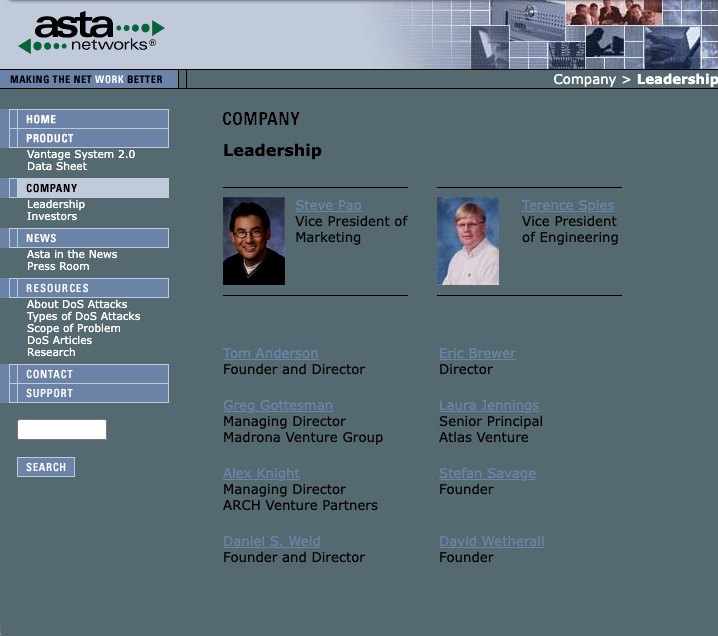
While I was still finishing up at Latitude, I happened to meet the CEO of Asta Networks. The company had successfully raised $18 million through its Series A venture funding, founded by four University of Washington professors to defend against DDoS attacks at the time when Code Red and Nimda still made headlines.
Unfortunately, the company had hired over 60 people, including growing sales, support, and operations teams, all well ahead of the product being completed or proving itself a fit with real customers. It had expensive downtown Seattle real estate on the 17th and 18th floors of 520 Pike Tower, which was Visio’s old space. The team had already burned through $11M, without any clear evidence that the prospective customers would actually pay for what the company had built so far.
The wind-down
In my first couple of weeks, I made a point to the other executives that we were far from a Series B funding milestone, such as closing the first 20 paying customers. It was going to be up to us to present to the Board a plan to reduce our burn rate to give us the runway we needed to support a follow-on funding round. What I didn’t anticipate was what happened four weeks later (six weeks after I’d started). The Board fired the rest of the management team and most of the employees, leaving me and the then director of engineering to lead a team of 17 remaining people.
As an interesting side note, there were some good people in the group that were let go. A fun fact is that the CFO who lost his job that day went on to become the CFO of Microsoft.
Right after the layoffs, we closed the first two customers ourselves (with very small deals), and we cleared out the rest of a sales pipeline that wasn’t real. From there, I hired a telemarketing company to solicit conversations with enterprise prospects, while we also pitched other vendors in Silicon Valley for potential ISV (independent software vendor) relationships or OEM (original equipment manufacturer) partnerships using our core technology. The hope was one of these activities might eventually lead us to new customers, or better yet, an acquisition. Both efforts got us meetings and good learnings, but no results.
The real problem at Asta was that the company had developed a tool to inform sophisticated network engineers and not a tool to respond to attacks. We learned through our interviews with enterprise customers and vendors that they really wanted a solution for Distributed Denial of Service (DDoS) that was closer to “set and forget.” The technology built by our team was essentially a NetFlow reporting tool, and remediating threats required the network engineers using it to formulate their own strategies to respond to attacks. Competing solutions that ultimately survived in the marketplace featured automated mitigations. (This is a lesson I took with me to Barracuda Networks, years later.)
Concurrent with enterprise and vendor meetings, I also led an effort to further reduce our burn rate beyond the reduced headcount. During that period, I led the cancellation of expensive Akamai and Internap contracts, liquidation of the networking gear in our lab, the auction of our old office furniture, and a clandestine physical move out of our expensive downtown office space. Our board packaged up a bankruptcy because the landlord would not let us out of our lease. With only 17 of us, we moved into some extra space in an office of another local Seattle startup (Vigilos, now closed).
Ultimately, after all the pitching to enterprises and other vendors, our best possibilities to potentially continue our business ended up being with two local Seattle area vendor companies. Those conversations were more like acqui-hire deals, but they didn’t close either.
At that point, it wasn’t worth keeping all 17 of us, so the Board cut us down to 4. At that point, we moved again, this time into Madrona Venture Group’s incubation space. We spent the remaining time there trying to pitch what we could do with the roughly $6 million that was still in the bank. However, what became clear to us at the time was that the Board was more interested in having us quietly weather through the dot-com bust until other companies in their portfolios started showing returns to their limited partners. In many ways, this was a much earlier case of what is referred to today as a “zombie startup,” where venture capital funds and private equity prefer to let startups limp along rather than take the write-down.
For a while, the four of us showed up dutifully to the office, brainstormed new company ideas, and spent a fair number of lunch hours trying (and enjoying!) every barbecue place in Seattle. Over time, we did get tired of not really accomplishing anything, so we planned our departures. The head of engineering ended up going to a Silicon Valley startup. He also referred me to a company that he’d been an angel investor for, AskMe.
Didn’t even learn the guitar
Immediately prior to joining Asta, I bought a Yamaha guitar at Costco and signed up for a beginner class at Bellevue Community College. However, midway through the term, I ended up missing about half the classes because of frequent trips to California to do partnership meetings with vendors. I fell so far behind the class and never picked up the guitar again. After years of usage by my older daughter and then a banishment to our storage closet, I pulled out that guitar and put it in my home office a couple of years ago. I even gave a tuner app a try for a few weeks in 2023, but it didn’t take, and I still haven’t really started practicing again.
If that period was supposed to be part of some positive change in my life, it didn’t feel like one. I just went back to another startup, but one that had no moments of commercial success. Even my guitar lessons didn’t survive this startup.
Seeing the glass half full
Looking back, at least spending time with the team at Asta gave me good exposure to the cybersecurity business. I mentioned above the benefit of learning how big security markets like antivirus and firewalls were “set and forget” and how automated mitigation was so critical for commercial success in this business. Beyond the business lessons, I also made a handful of friends that are still part of my life today. A couple of them even read this Substack!
Tomorrow’s post picks up where this leaves off, with my move to AskMe for my next Seattle startup adventure.
Hmmm. Interesting story. Sounds somewhat painful
I had something similar happen TWICE after Latitude. First, a company called Noosh, a b2b play for the printing industry, hired me to run the western region.
On my 2nd day, they fired the guy who hired me and I was left adrift in a wildly disorganized organization with an ill conceived product and sales team that they hired from the print industry, giving then salaries of $250K and more. It was insane, they'd lied to me about their market traction, but somehow I lasted 18 months and during that time not one deal was closed. By anyone.
And then it got worse.
By 2001-2, the tech boom was over and good opportunities were minimal. A guy you knew, Jeff Hudson hired me as a Sales Director for a company named MS2; an even worse product with zero market appeal. He also lied about their market appeal - there was none - and within 2-3 months they started laying people off. Classic case of "let's get some new sales people in here to save us".
I could go on. As I look back, I had a **good** career that could have been much better had I made better decisions. But I definitely don't miss the career ups and downs.
Sorry, this got long. Great article by you