


Editor’s Note: This post is part of a series about leaving Silicon Valley for a short stint in Seattle. It’s part 2 of a series that started with yesterday’s post about my experience with the first startup I joined after moving to Seattle that then led me to join AskMe.
A Warm Intro
After departing from Asta Networks, I was still looking for the change from my life in Silicon Valley. AskMe also proved to be a very different experience, but also not the one I’d really hoped for.
On its surface, this one seemed to be a little closer, actually. Much like how I joined Latitude, I got a warm intro. The engineering head at Asta Networks was one of the angel investors and knew one of the company founders very well. The company was in the midst of its own reset, as it was in the process of winding down its dot-com era consumer presence and pivoting to become an enterprise collaboration vendor. I was somewhat familiar with this space from my time at Latitude.
Overcoming Some Known Challenges
AskMe was also a VC-backed company, originally founded to be a consumer Q&A website. At its consumer peak, it was a PCWorld Top 100 site, with over 10 million registered users and over 5 million knowledge articles in its knowledgebase. At the time, markets weren’t as friendly to companies relying on Internet advertising for revenue, so AskMe saw an opportunity when both Procter & Gamble and CNA Insurance had approached the company to create internal company versions of the software.
Before I joined AskMe, the company let me speak with the existing customers. One of those conversations was with a director at P&G, and he did a good job explaining the cultural value of AskMe inside of P&G, where Ph.D.’s across different business lines appreciated having a platform where they could openly collaborate and share ideas across functions. Because their work was proprietary to P&G, they weren’t able to publish academic papers or attend conferences to share with outsiders, so the platform served as an internal social networking tool, where experts inside of P&G could find each other, pose questions, view conversations with others, and add their own comments. I saw the potential.
Of course, I remained a bit skeptical, knowing the difficulty with enterprise sales, and I knew the return on investment (ROI) would have to be quite “soft.” Unlike Latitude’s platform where costs could be compared against actual telecom costs with old school teleconferencing, justifying AskMe in some way required attempts to quantify the value of making a connection, the value of capturing previously tacit knowledge in a knowledgebase, and even the re-use or spreading of knowledge. I understood the challenges, but I was intrigued.
I joined AskMe as its VP of Marketing through its pivot into an enterprise player. We went on to close several more name-brand enterprise customers, including Boeing, Honeywell, Ford, ABN Amro, and others. The value proposition was “Expertise Location and Management” which was a fancy way of saying that we connected people with similar expertise that didn’t know each other inside of very large enterprises.
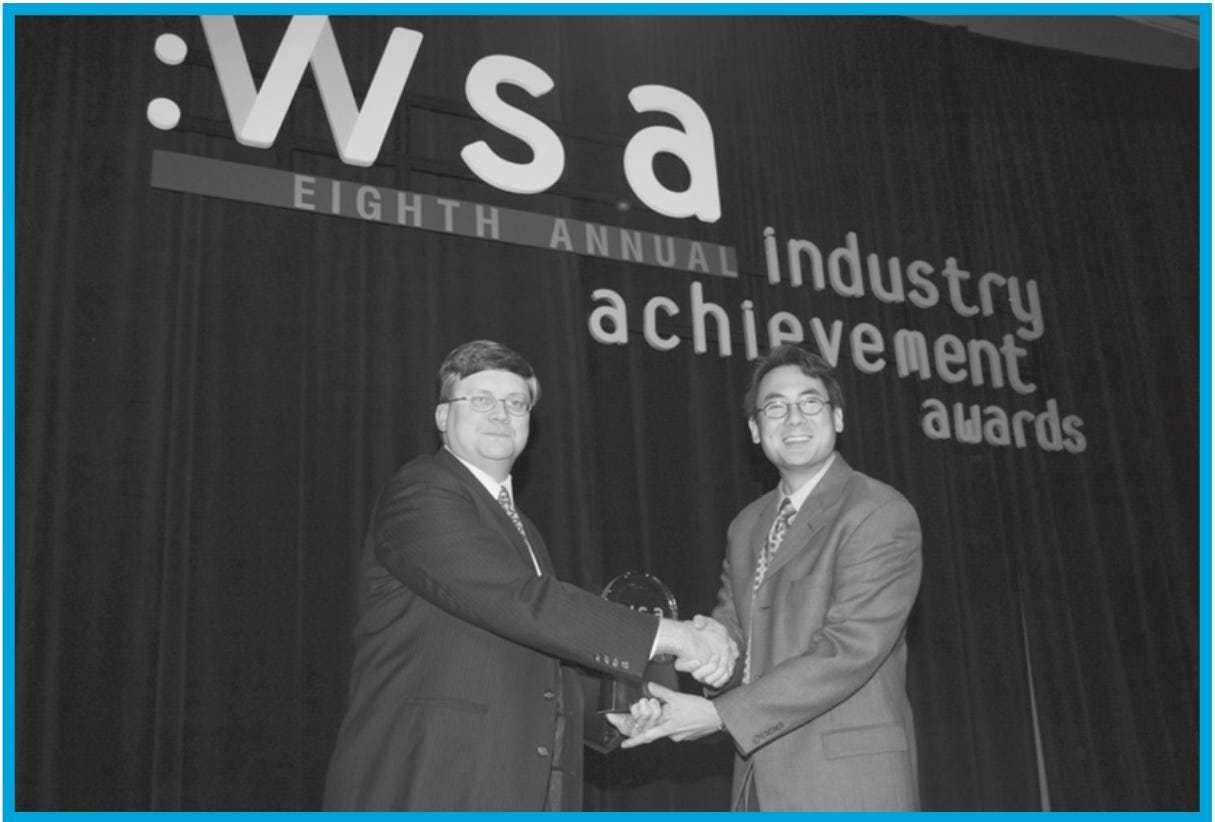
We won some real recognition, including an SIIA Codie Award for “Corporate Newcomer of the Year” and the WSA (Washington Software Alliance) “Most Promising New Company.”
Another downsizing
Of course, the issue we ran into was that these very complex customers were, by definition, the most complex organizations to sell into. We were able to utilize affiliations with organizations like APQC to find member companies with enterprise knowledge management initiatives underway. However, once we tapped those lists, we faced the difficulty of trying to sell such a soft value proposition during an economic downturn.
Ultimately, we downsized the company, reorganizing ourselves around a partnership model where every executive was responsible for selling and supporting a set of customers within a vertical. I moved from VP of Marketing to VP of Life Sciences. Eli Lilly and Pfizer were two of my accounts. This move was a slog. Once we made that change, I spent most of my time prospecting a long list of life sciences companies, with very long sales cycles. Our Pfizer relationship came in through AskMe’s consumer vertical, and the Eli Lilly relationship came in through the acquisition of a company with an adjacent product, rather than through anything I closed myself.
Through our downsizing, I took on more than just marketing just like at Asta. In this new model, I led the cancellation of our TriNet contract, the outside firm handling our payroll and benefits. I took over the implementation of insurance, payroll, and benefits in-house with our office manager. I also owned IT and data center operations, so I managed the IT person responsible for our spam problems, our backups, and the daily realities of a small internal data center.
Through that period, I also owned many of the logistics of our eventual office move. The earlier AskMe office was a typical dot-com space, and our lease happened to end right as T-Mobile’s acquisition of VoiceStream freed up their old Class A office space for a cheap sublease. We also were able to use the on-premises switch room as a data center, allowing us to cancel our Internap contract for hosting. We got a serious office upgrade, sharing the same office complex as Expedia at the time, at a bargain rate!
What I learned about being at that company was the power of being “hard core” economically. (This was a term frequently used within the company.) Even though we didn’t sell many new customers in our later years, the company stayed alive by selling professional services to installed base customers. In these large enterprises, AskMe integrated with internal Verity, Autonomy, or even SharePoint applications to help identify who in a company had already written about a particular topic. To integrate with an enterprise’s existing systems, we’d charge $250 per hour, but paying an Indian outsourcing partner about $16 to do the actual work. We were running software margins on a services business.
So, the company was surviving, not thriving.
Unexpected Health Issues
During this period, at age 36, while training for my fifth marathon, I found out I had an unusual case of Type 2 diabetes. The diagnosis itself came as a surprise. A high school friend who had become a financial advisor encouraged me to purchase a life insurance policy. During the application process, a nurse came by my house to draw my blood and take my vitals, commenting that this was just a routine check for someone as fit as I seemed. I was rejected outright, only to find out the reason was a completely asymptomatic case of uncontrolled type 2 diabetes. I was just walking around with an A1C of 11!
This health news simply provided another signal that my move back to Seattle wasn’t really getting me closer to what I wanted out of life. Ultimately, I decided, with the support of the company, to really take some time off from my career.
What AskMe Was For
While AskMe did end up surviving (and got purchased by Realcom of Japan years later), it never really made a lasting impact on the industry. The whole category of Expertise Location and Management ceased to be a category. The closest example of the application that exists today is Quora, which is more similar to the consumer-facing business that AskMe abandoned as I joined. Probably the more relevant example is the business case right now being made with AI, where the intention isn’t to locate the expert but rather to capture the expertise so that an agent can mimic the expert in their absence. While there’s a substantive difference between locating the expert and replacing the expert, the business case still requires a soft-dollar argument.
Like with my situation at Asta Networks, this time at AskMe produced some good lessons and some good friends. However, the net is that those three years did not feel like “winning” at the time.
During my time in Silicon Valley, Oracle was growing fast. Visioneer debuted as #1 on the Ingram Micro Best Seller List and ended up going public after I left. Latitude had enough success to do an IPO. Asta had no successes, and AskMe had a very short-lived run to profitability before essentially stagnating. This stretch of life certainly didn’t feel like an improvement over what I left in Silicon Valley. It was time to try something else.
Next week’s post picks up where this leaves off, with a complete departure from technology startups.