


Editor’s Note: This is the third of four posts describing my time in Seattle after leaving Silicon Valley the first time. If you missed the previous two, I suggest you start with the first one describing my time at Asta Networks, followed by a stint at AskMe.
Time to myself
Of course, during this period from June 2004 to January 2005, I remained concerned with the same question, which is what I want to be when I grow up. This period didn’t provide a complete answer, but it brought me closer to it.
I left Silicon Valley wanting a change. Three years and two startups later, I didn’t have an answer, and I now had a diabetes diagnosis that made it even more clear that my life needed to change. I last left this story on the note that I resigned from my role at AskMe. I didn’t have a plan for what would come next, and the decision to just stop working altogether didn’t come easily.
Marsha made the subsequent journey possible. She stated explicitly that she didn’t want me to spend my time off work by assuming the role of “Mr. Mom.” She supported taking real time for myself and not just trading a job outside the home for a job inside the home.
Of course, anyone who has taken time off from work at age 37 knows that doing so isn’t all fun and games because there aren’t any playmates. In my case, Marsha had our kids to look after and, other than the one month we took off in the summer for a driving vacation, wasn’t really available to keep me company. My other Seattle area friends were all still working full time.
At the same time, I couldn’t just immerse myself in long runs and bike rides. I wrote earlier about how I’d become a marathon runner after returning to Seattle, and I’d even done some good distance cycling having done a 1-day STP (Seattle to Portland) bike ride, a double century, and all of its associated training rides just a couple years earlier. Unfortunately, with my doctors unsure of either the cause or the treatment for my somewhat unusual case of diabetes, they were worried about the risks involved with endurance athletics for me. So that door for even more running and cycling closed just as I finally had the open time to do it! Basically, when I wasn’t volunteering for a nonprofit, or seeing friends occasionally on weekends, I spent most of my time alone.
Books and their impact on me
I read a lot, including books on spirituality, life stages, and natural health. I think that throughout this period, I was in sort of a Taoist flow. I would think of a friend, and the friend would call me. I would think I need to try something and someone or some opportunity would appear. Candidly, that hasn’t happened to me in any other period in my life.
For example, when I thought I should perhaps do some non-profit work, a contract recruiter I had met through my time at AskMe called me with an idea and to introduce me to a non-profit she was involved with. I’ll leave the organization unnamed, but its founder had written a bestselling series of spiritual books that I genuinely liked. Some of what I was reading really resonated with me. I did stay involved for a while before deciding I didn’t want to invest my time that way long-term, and the bigger issue for me was less about the individuals or the cause itself. I had just gotten used to a set of work patterns during my time in Silicon Valley and realized I wasn’t trained to work in more of a volunteer setting.
I also got my first experience with life coaching. I partnered with this same recruiter on conducting my first ever life coaching workshop. We put up handmade signs on telephone poles around town, and ran the workshop out of the store of one of her friends. I still find it hard to believe that people actually showed up and paid for it!
I remember thinking that I needed a framework to decide the next phase of life, and a stranger in the waiting room of an environmental medicine doctor (alternative health) recommended a book called Halftime: Moving from Success to Significance by Bob Buford, which was good reading material and the start of my reading other books on this topic. It’s largely written from a faith-based perspective but provided some good frameworks to think about what I was experiencing in a different context. I was also starting to get into works like Carl Jung’s essay “The Stages of Life.”
I also tried to solve the diabetes itself from more than one direction. The “standard of care” in Western medicine at the time was not giving me solutions that worked, so I started reading medical research papers and books. For a time, I thought I had a solution that worked (Dr. Bernstein’s Diabetes Solution), and it, combined with some other lifestyle interventions worked for a while. I also did my first 7-day water fast in that period, too. It turns out none of the lifestyle interventions turned into a permanent fix.
Photo Kiosk Business
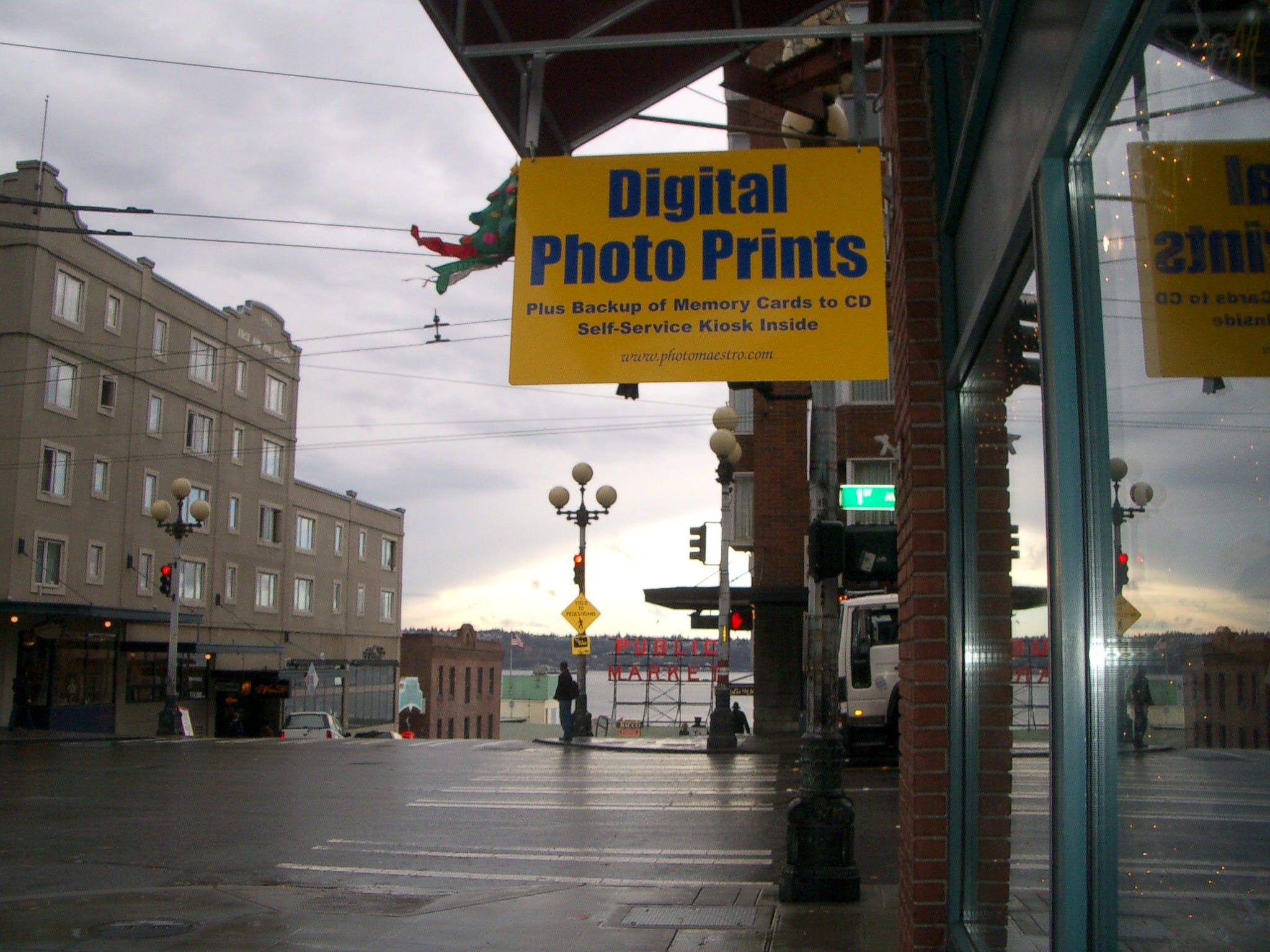
During this period, I also decided to go into a little solo business of my own. I started by buying a photo kiosk, with the intent of potentially making passive income by having a network of them once the first one proved successful. The concept is that the kiosks would allow people to print quality photos on the spot from an SD card and other popular memory formats or to back up their SD cards to a CD. The aim over time was to purchase more and ultimately hire someone to replenish the supplies (e.g., paper rolls, ribbon rolls, CDs, and receipt rolls) while I collected passive income.
It actually wasn’t hard to get a machine placed at first. I put my first machine at a Simply Seattle tourism shop at the Pike Place Market which had good foot traffic of snap-happy tourists. I basically did a 10% revenue share with the shop, and early customer feedback was reasonably positive. The owner let me just use the electricity there and share the Wi-Fi. He also gave me prime placement, right across from the cash register.
The problem was that the built-in printer was notoriously finicky and would jam. I couldn’t always get to the machine to repair it in time, and users would ask the store employees for help. The whole thing proved to be too much of a distraction for that Pike Place store, so they asked me to move the machine to their downtown store. That store didn’t provide the foot traffic of the Pike Place Market store, and it wasn’t worth either of our time to keep it there.
To address my personal inconvenience of service calls, I then moved the machine to a store closer to my home at a higher end neighborhood grocery store called Matthew’s of Lakemont. (It’s actually the site of where the Town & Country Market is today). One difference in that location is that the store’s IT department wouldn’t let me share the same Wi-Fi connection as their point-of-sale systems, so I had to get my own DSL line, which ate into my profits. The bigger problem was that in a neighborhood environment, people could easily compare the high cost of my low-volume process with the much lower cost of going to a high-volume provider like Costco to get professional quality photo printing. There was some business, but ultimately, it became clear that the goals of optimizing the kiosk location for being easier to service the units was incompatible with the ability to capture foot traffic of potential users with no other convenient options available.
I ended up taking the kiosk home and using it for my own photos before selling it on eBay to a camera store that used it in-house. The kiosk made much more sense in an environment where store employees were already on-site to take care of the machine. My problem was just that the printer used in the kiosks was just too finicky to make for a good passive income business, and ultimately the manufacturer went out of business because other operators had similar experiences.
Moreover, much like with my volunteer experience, I also learned here that I didn’t enjoy working as a solopreneur. Again, perhaps because I was trained in a Silicon Valley environment, I enjoyed having smart colleagues to collaborate with, people to challenge me and tell me when I’m wrong, and also to celebrate wins with. There wasn’t anyone around to celebrate with when getting my first location signed or getting the first customers and no one else to commiserate with when deciding to shut down the business. I started to see positives in the style of work that I was looking to get away from originally.
The beginnings of Hillwork, LLC
Of course, one artifact of starting this little business was that I had to collect sales taxes and report revenue to the state. With the help of a lawyer friend, I ended up creating an LLC. The LLC structure was a good choice for me because I didn’t want to personally go bankrupt if someone ended up using my photo kiosk for something that might end up in a lawsuit.
I ended up choosing the name Hillwork for my entity. I liked this name because of my days as a marathon runner, and I liked hillwork because it was the one part of training that makes runners stronger. I felt like this term also described the period of life I was in, one that would make me stronger.
Even though Washington state required that I run a name search against other companies in Washington, I didn’t know at the time how to run the search nationwide, so instead I just bought every domain (hillwork.com, hillwork.net, hillwork.org, and hillwork.us) figuring no one else could claim they owned the name if they didn’t have any of the domain names!
What I didn’t realize at the time is why the name kind of sucked. When I showed up to the bank to open my business checking account, the banker thought I was in construction doing grading and excavation. Others have also asked me if I run a landscaping company.
In any case, there is some history behind why I even bothered to do an LLC just to do independent consulting where I could have settled for a sole proprietorship. It’s all because my first business was a photo kiosk business that faced the public, not a consulting company to do work with friends.
The realization
This seven month period was full of “low cost probes” (a term used in Halftime). I haven’t listed them all here for brevity. However, in spending time by myself both reading and doing some introspection, I realized what the themes of movies like The Wizard of Oz are really about.
In that story, Dorothy goes on a long journey with many adventures only to end up back at home. She doesn’t know the journey will lead her there. She just follows the Yellow Brick Road until every step gets her back there. Along the way, every experience she encounters turns out to be something the characters needed to just see. Tin Man always had a heart, Scarecrow always had a brain. Lion always had bravery. They didn’t need the Wizard to give those things to them.
My favorite movie of all time was The Matrix. (I can’t use “What’s your favorite movie?” as a security question any longer because I tell everyone this!) After discussion with a high school friend (the same one who encouraged me to try to get life insurance resulting in my first diabetes diagnosis), I realized The Matrix was something similar. Hanging on the Oracle’s wall was “TEMET NOSCE”, Latin for “Know Thyself”. The main point here was that the whole movie was a series of experiences to get Neo to build up the confidence himself without the Oracle ever giving him the external validation.
So, as I was taking this random walk through the seven months, I realized that perhaps the right thing to do was to start returning to the work world I was more familiar with. Like Dorothy, I didn’t expect each step of the journey to lead me back to the path from where I came from. And like Neo, I didn’t expect that the real journey was going to be knowing myself.
A New Year’s Resolution
In January 2005, after over six months off I decided it was time to return to the working world. I wasn’t sure I was ready to join something full time, but perhaps I could do a part-time consulting gig. I set a New Year’s Resolution to start the process to find something. I didn’t have any idea of what I was going to do.
I mentioned before that I was in a Taoist flow that year. Out of the blue, a contact whom I’d met during the seven month break had reached out to me. He was a consultant in the Seattle area (a former Microsoft product manager, best known for introducing Clippy to Microsoft Office). He told me that he had a friend that was looking for some help, and that he was too busy to take on the work himself.
That referral turned into my first consulting gig and favorite of all time.
In two weeks, I’ll tell the story of that consulting gig and my eventual return to Silicon Valley.