


There’s been a lot on my mind this week. Good medical news, an AI rabbit hole that’s raising hardware prices for everyone, a savings hack from Marsha, and (of course) another rant. Here’s the mixed bag.
Health. Thanks for all the nice notes after my last post (The Detour), which described the vascular issues I need to resolve before a potential kidney transplant. This past week, I saw the cardiothoracic surgeon, and he let me know that the transplant team has decided to let me skip the bypass surgery for now in favor of PCI (stents). The basic explanation was that if it weren’t for my kidney disease, bypass surgery (CABG) would be the way to address my coronary artery disease. However, the multidisciplinary team agreed that my best path forward is to address the kidney issues first. This doesn’t take cardiac bypass surgery off the table for the future, but at least such a major operation isn’t holding me up. I am still awaiting word on next steps for stents.
Reflections. In addition to my physical health, I have also been looking to change psychologists. I like my current therapist, but she doesn’t have as much experience with alexithymia and neurodivergence (something I’ve written about before). She likes to refer to the “feelings wheel” and this type of tool isn’t as useful for me. So, we agreed that we’d take a little break while I interview other therapists, and our couples therapist was able to help me assemble a list of people to interview that have availability and that have many neurodivergent clients. The bummer is that my current therapist was in my health plan’s EPO. The two I like the most from the list are out-of-network for me. Boo.

The good news is that I was able to use AI to help me both parse the “pitch” emails responding to my own couples therapist for referrals, as well as to visit the websites of all the therapists for fit. While I chose to interview them myself, it summarized the upfront research really well.
Business. Speaking of AI, I’ve been so impressed with the relative ROI of AI. I am getting much more value from it than what I’m paying for in subscriptions. However, the piece of this I’m not sure how to measure is how much the AI boom has increased the costs of everything else. For example, a conventional 32GB (2x16GB) DDR5 memory kit sold for around $100 to $200 in October 2025, but the same kit now starts at $350, if it’s even in stock. (Tom’s Hardware, Consumer Reports). The memory shortages are even affecting the PS5 gaming market (TechRadar). All of that traces back to the same root cause. AI data centers are on track to eat up around 70 percent of the world’s memory output this year, and Samsung, SK Hynix, and Micron have shifted almost all their production toward feeding them (IEEE Spectrum, CNBC). Most analysts don’t expect real relief until new fab capacity comes online in 2027 or 2028. The most visible impact for me personally is that Apple has raised prices across MacBooks and iPads. The M4 iPad Air had already gone up $150 by the time I got to it. I missed Prime Day, which would’ve caught the old price, and by the time I bought it, the higher price was all that was left. I paid the new price.
Tech. So, why did I buy the M4 iPad Air? My old iPad was a 9th generation iPad (with only 3GB of RAM), and with iPadOS 26, it was running pretty slow. While I considered buying a newer 11th generation iPad, it only has 6GB of RAM. I decided that with the new Apple Intelligence features, getting 12GB of RAM would be more future-proof, so I got the M4 iPad Air. I know this is likely overkill for iPadOS right now, but I didn’t want to be constrained in using AI in my ecosystem.
Finance. To mitigate at least some of the cost increases for Apple products, Marsha pointed me to Capital One Shopping, which had a 9% cash back offer running on Apple purchases through July 4th. It was pretty straightforward to just click a link in an email, buy the product, and get the rewards. We got $83.52 back for the iPad and case.
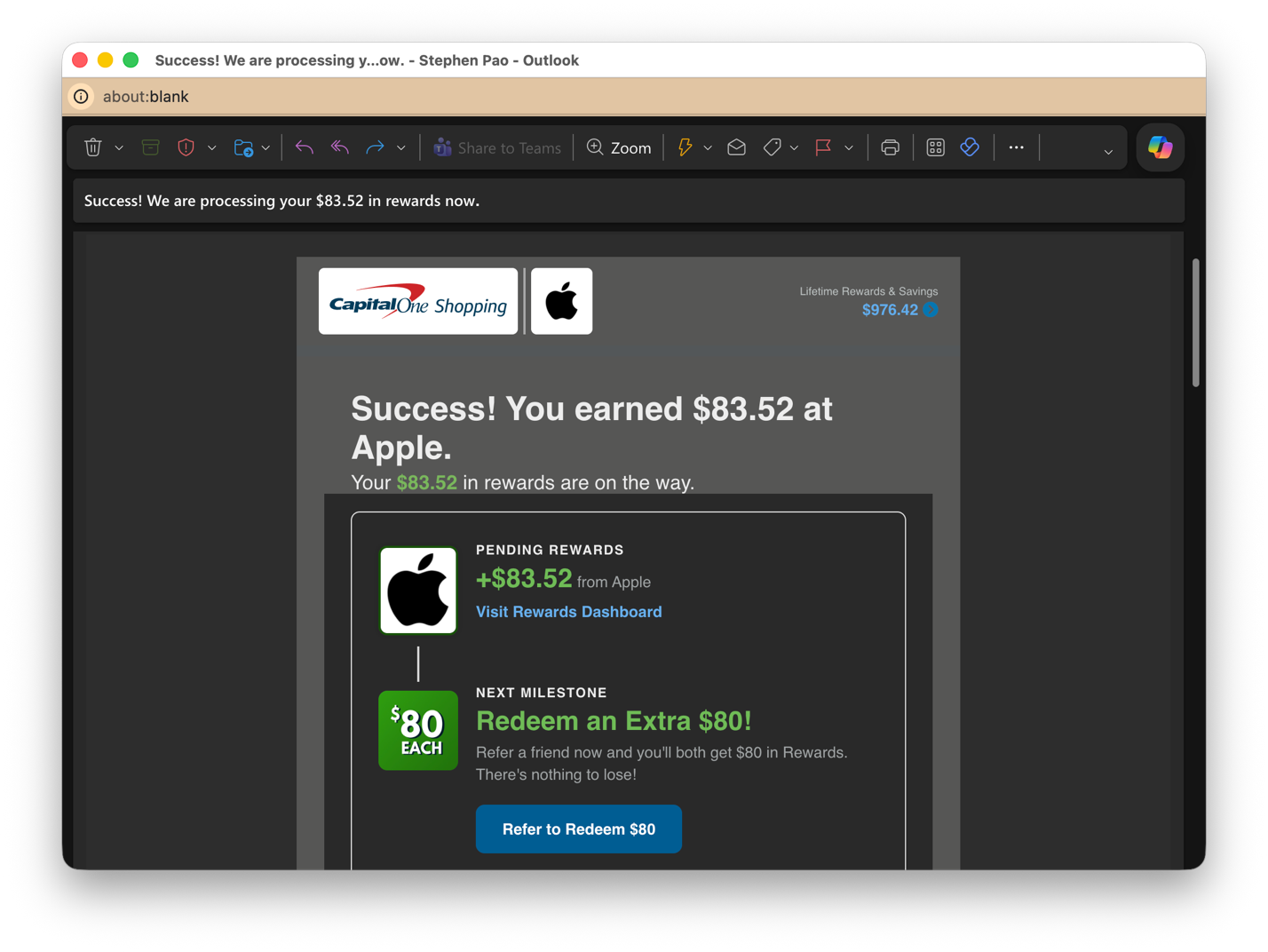
Even when Marsha doesn’t get the emails, she often uses the “cart abandonment hack.” (Yes, look it up!) This time, she added an NMR LipoProfile test from Life Extension to her cart and then walked away. The next day, she got an email offering her both a discount and cash back on the test. For anything you don’t need immediately, this hack is a good one!
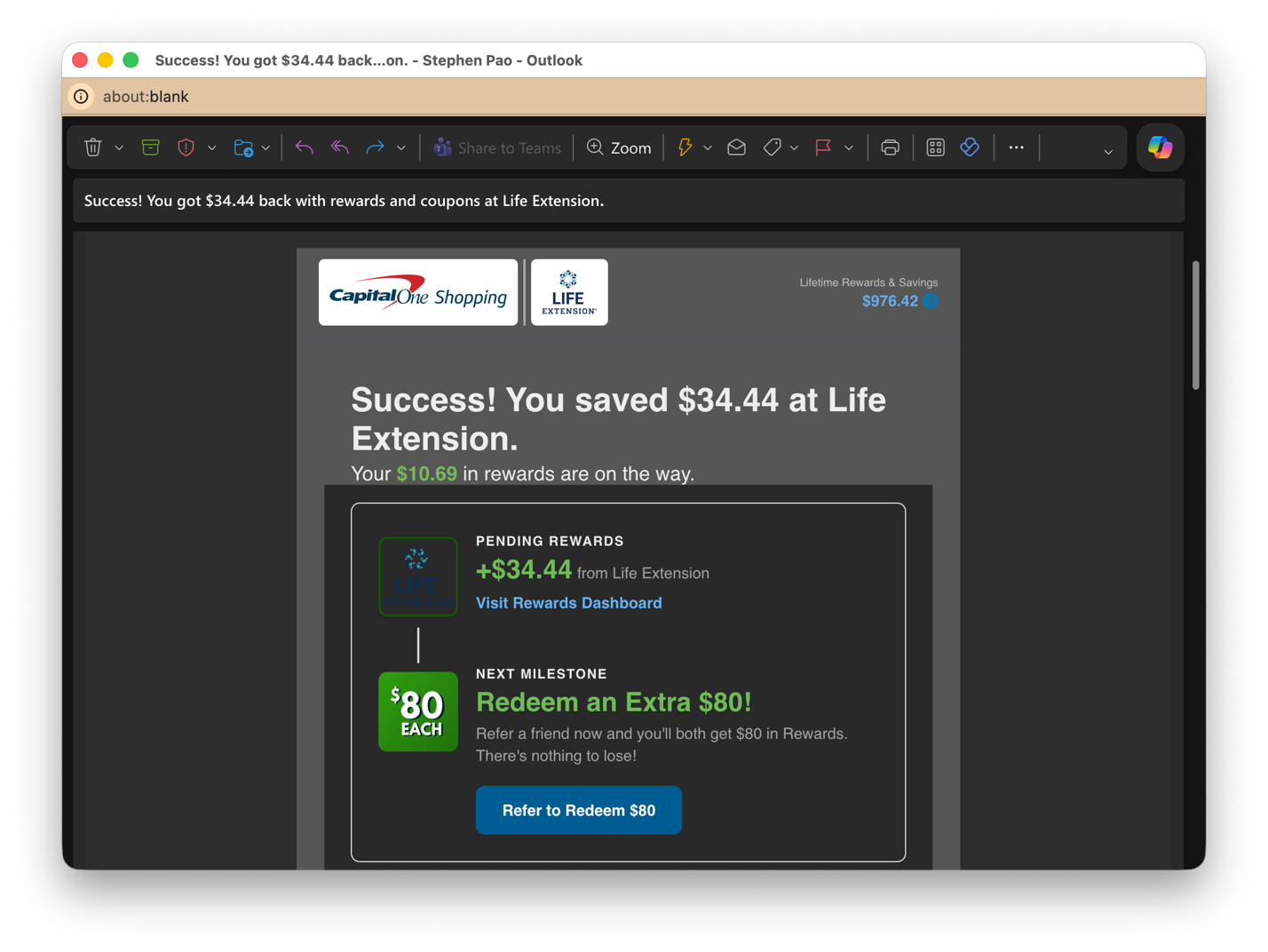
The backstory: Marsha has “pattern A“ LDL, which is protective and not at all a risk for cardiac issues. However, the cheap tests ordered by PCPs don’t test for this by default, so we had to order that NMR test on our own. Knowing that Life Extension was a Capital One Shopping partner is exactly what made the cart abandonment trick above possible.
PNW. This is July 4th weekend and the first year in a while that we haven’t had the Portland Craft Beer Festival. What a disappointment! This event used to be literally on my block in the Pearl District, and with a construction project in the Fields Park where it was held, they moved it to Elizabeth Caruthers Park down in South Waterfront. This year, they’re not doing it at all! I’m super disappointed that the number of beer events here in the city have dwindled quite a bit as of late. (I will be out of town for Fuji to Hood, which is a cool collaboration between Portland and Japanese brewers). So, it looks like the next beer festival for me will be across the county line in Washington County, which is the Tigard Brewfest out in the suburbs, suggested by a couple of guys who live out there in our beer group.
Politics. And, of course, this week’s rant. As much as I love Portland, I’m frustrated watching our income tax base leave. This isn’t just my imagination, and it isn’t a settled question either. There’s been a real fight over the numbers. Governor Kotek and a Tax Advisory Group report pointed to a big jump in the average income of people leaving Multnomah County as proof that high earners are fleeing the county’s Preschool for All tax (Axios). The county’s own commissioned rebuttal pushed back hard (Portland.gov), pointing out that a simple average can be wrecked by just one or two ultra wealthy households in a small sample, and that people who move to the suburbs might still be commuting into Portland and paying the same taxes anyway.
So I went looking for someone who actually controlled for that outlier problem instead of eyeballing an average. There’s a new academic paper (Conway, Iselin, and Rork, 2026) out of the University of New Hampshire, the Budget Lab at Yale, and Reed College right here in Portland that does exactly that. Instead of a raw income average, the authors used two independent datasets and a battery of causal inference methods, including placebo tests where they check whether every other county in the country would show as big an effect if they’d gotten the same tax. The result held up. Adjusted gross income leaving Multnomah County rose by 3.7 percentage points after the tax took effect, worth about $1.4 billion a year, and Oregon’s state income tax take from the county dropped by about $78.6 million a year because of it. This isn’t a couple of billionaires skewing an average. It’s a real, measurable effect.
The honest caveat, which the authors raise themselves, is that this tax launched right at the start of Covid, alongside the George Floyd protests and drug decriminalization, so some of that exodus probably isn’t about the tax alone. And relative to the whole county economy, the hit is modest, a few percent of state tax revenue, not a collapse. But modest is not zero, and it’s stacked on top of a housing affordability problem that’s pushing out exactly the people we need to keep. That combination, the tax and the cost of living, is a big part of why, for the first time, getting to a beer festival here means getting in a car. I’ve walked to every one of these in the city until now.
So that’s the week. Cardiac reprieve, a decent research assistant in the AI, a discount well earned, and a tax base still leaking out the door, for real, measurable reasons this time. On to whatever comes next!
AI disclosure: I used AI tools during the drafting and editing process to help clarify structure and language. All ideas, judgments, and final wording are my own.