


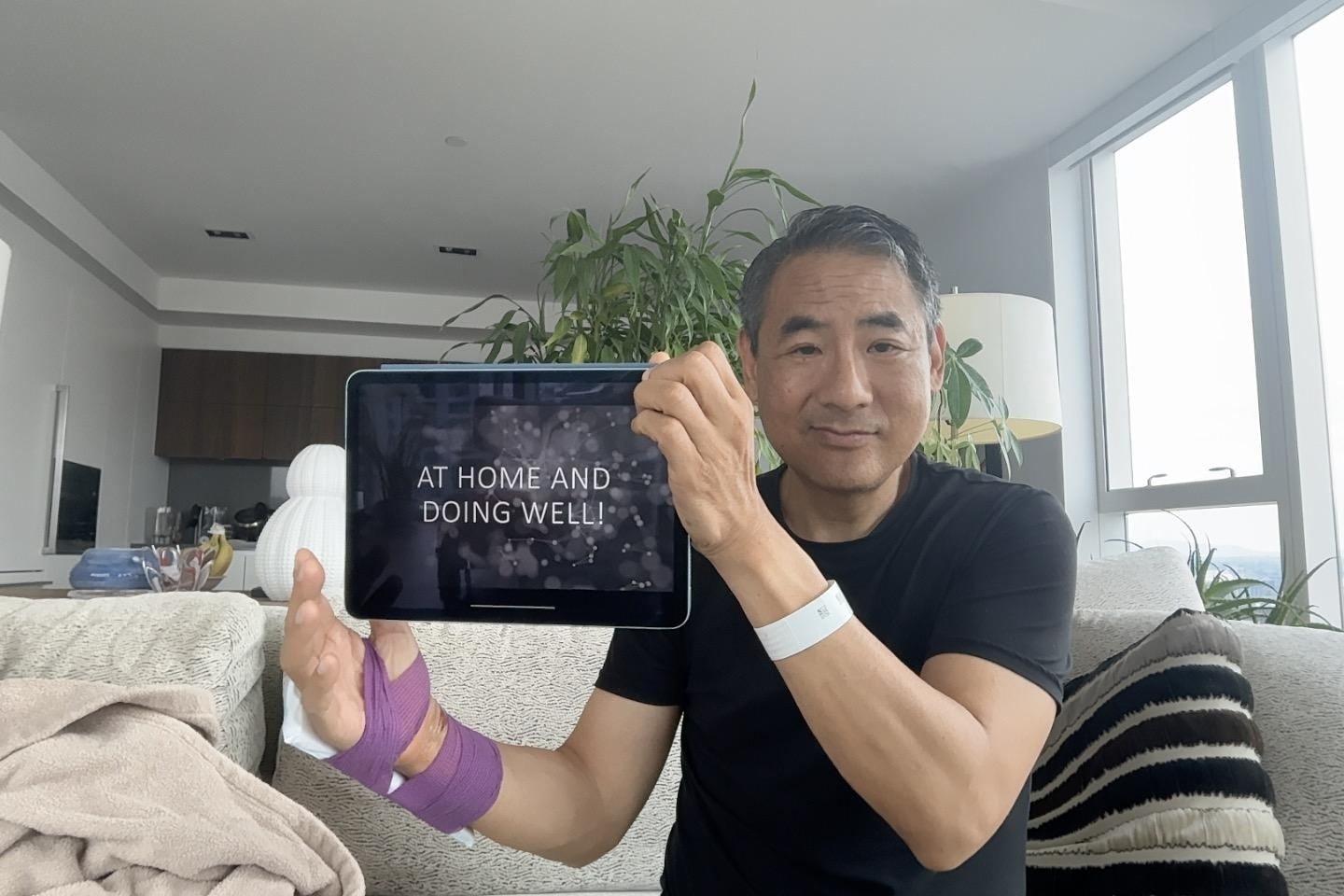
I had my first stent placed on last Friday (August 14). I am grateful to all of whom reached out with support and to check in on how I’m doing. I figured it would be appropriate in this Substack to describe the experience, both to let everyone know I’m fine, as well as to help give a sense of what to expect to others who might go through this themselves or with a loved one!
Part of a bigger plan
This stent placement is not a new development, but rather the next chapter of my kidney transplant story (see “The Detour” and the quick follow-up for July 4th). For those who haven’t been following along, I had a coronary angiogram done as part of the kidney transplant qualification process. That angiogram found five blocked locations across three arteries, including a major one that is typically associated with the “widow maker.” (For those who like the technical terms, my LAD was 80% blocked.) The two other arteries were blocked at 90% and 99%. Multi-vessel disease like this technically made me a candidate for open heart surgery, but the multidisciplinary transplant team concluded that the best way to extend my life was to avoid the delay associated with recovery from open heart surgery. The final decision was to do multiple stent placements (“staged PCI”) for two of the arteries, and medication for the rest. So the procedure last Friday was just part of the plan. Admittedly, all of this heart disease treatment has been somewhat surprising to me, as I have been otherwise asymptomatic this whole time.
I’m scheduled for the second stent October 5th. It can happen sooner, but I had previously scheduled travel from September 9 through September 28, so I opted to delay it. This decision will stretch out how long I need to stay on a daily dose of Plavix (a blood thinner), but I’d rather use the time for my kidneys to recover from the exposure to contrast dye used for the stent placement, as well as to enjoy the time with friends and family.
The day of the procedure
I had the stent placement done at OHSU, as part of the multidisciplinary care I’m getting for the kidney transplant. I also utilize OHSU for nephrology, endocrinology, sleep medicine, and ophthalmology. I’ve been genuinely happy with the care I’ve gotten there.
5am - I set my alarm for 5am, so I could shower and get ready. Probably the most important thing to do was to keep taking my normal medicines. I was allowed a small sip of water for the pills, but I skipped the water anyway. I was instructed to fast from midnight on, and I hadn’t had anything to eat since 6pm the previous day. Marsha had to drive me to and from the hospital, so she was up right with me!
6:15am - I arrived at the procedural care unit, where they started my IV fluids to protect my kidneys from the contrast dye used during the procedure.
8:30am - I was wheeled into the “cath lab.” My nurse played a Depeche Mode Spotify playlist at my request, and we talked while he prepped me. He told me everyone on the team there was from outside the area, that he was from Cleveland, and that he loves living in Oregon for the mountain biking. Before the procedure itself, they called a “timeout”, where I had to state my name, my birthday, and what I was there for. Then they gave me sedatives, including fentanyl, and I don’t remember much else until the procedure was over.
10am - I was back in the recovery room. The official OHSU policy is one visitor at a time, but my nurse let both Marsha and a close friend of mine, a retired doctor, stay with me. Having a friend with medical training in the room really eased any anxiety I had through the process and that peace of mind was very valuable. He could ask questions and hold onto answers from the nurse, the pharmacist, and the cardiologist while I was still coming out of sedation.
While recovering, I got to order a meal. I had the option of breakfast (until 10:30am) or lunch. I asked the nurse what most people preferred, and she guided me to breakfast. I had a fruit cup, oatmeal, English muffin, cream cheese, Greek yogurt, breakfast potatoes, and 2 eggs. There was a 7-item maximum, and I took advantage of it all! They ended up rejecting my request for huevos rancheros because of the overall sodium load across everything I ordered!
1pm - After recovery, I stopped at the OHSU pharmacy for three months of Plavix, even though I’ll need at least six months total. They told me I can transfer the prescription to Amazon (who I normally use) or just stop by there again in 3 months. For others who go through this, know that in addition to needing to take Plavix afterwards, there was also the requirement for me to take a “loading dose” of Plavix (300mg, 4 x 75mg pills) on the night before the procedure, and 75 mg (1 pill) the morning of the procedure itself. I’ll need to stay on this blood thinner for six months after the last stent placement before a kidney transplant.
2pm - I got home safely and spent most of Friday afternoon resting, drifting in and out of naps in front of YouTube. Meanwhile, Marsha went out for provisions in preparation for the next few days.
6pm - My incision site oozed a little after I got home, so I called the after-hours line at OHSU. The on-call cardiologist called back and told me that was normal, explained what to watch for, and said I could call again or come in if I was concerned.
7pm on - We had some excellent salmon that Marsha’scousin caught, smoked, and vacuum sealed for us. I meant to watch more YouTube afterward, but I was out on the couch for the rest of the night instead.
Going forward
The next day, I was still operating a bit more slowly but I have been getting better by the day.
I spoke with the OHSU cardiology nurse via phone on Thursday, and he cleared me for travel. We’re leaving September 9 for South Carolina to see my older daughter, and then on September 14 for Europe. For the ten days in Europe, I’ve purchased international travel insurance that covers both emergency medical and medical evacuation. With BlueCross BlueShield Global Solutions, it’s about $100 for Marsha and me combined, including the coverage for pre-existing conditions. After the Europe trip, I’m also scheduled to go on a guys’ trip September 25 (with the same guys I went to Sedona with last year), where I’ll have to be very careful not to fall while hiking or mountain biking because of the blood thinners!
When I return, I go in for the second stent. After that, I’ll have a referral for a 12-week cardiology rehabilitation program, six months on Plavix, and then I should be ready to schedule the kidney transplant.
The takeaways
For anyone facing something like this themselves, or with someone they love, here’s what I’d want them to know.
The procedure itself is straightforward.
The OHSU staff were extremely well rehearsed, as it seems they are doing this all the time. The cardiology fellow who did my orientation was almost like a hospitality host. “Thanks for joining us,” she said. “We appreciate you coming in so early to be with us.”
The real surprise for me was how tired I felt once I got home. I’d had Sunday’s Substack post pre-written just in case, but I thought, perhaps naively, that I’d feel more up and at ‘em, since the angiogram itself hadn’t been bad. It turned out to be a similar procedure with a very different level of fatigue afterward.
Gratitude
Thank you to everyone who reached out this week. I have a special amount of gratitude for Marsha, who has been there through every step of the way and continues to be. Also, special thanks to my retired doctor friend who has been advising me throughout all my medical test results and who stayed with me and Marsha during my recovery! I also must recognize Marsha’s cousin who gave us that yummy salmon caught in Roche Harbor!
Thanks for sharing! Am very glad to hear you're recovering well!
What a journey Steve! I pray you get better soon and are able to enjoy your annual travel with the Latitude gang.