


A rough start
Even though Marsha and I had been friends since we were twelve, our marriage had a bit of a rough start. Marsha’s dad was not supportive of us getting married and made declarative statements to that effect. Ultimately, we had a small wedding with only my parents and sister attending, and we didn’t communicate with Marsha’s parents for about two years. This situation took a toll on both of us, and it led to Marsha’s first experience with individual therapy. She had to come to terms with the concept and the reality that she was without a family of origin. We did our best to just move on with our lives, and, in some ways, life became easier to navigate.
Once Marsha was pregnant with our older daughter, some repair came about. The coming of a grandchild prompted Marsha’s cousin’s wife to confront Marsha’s dad. She laid out very clearly that on the current course, Marsha and Stephen would just live happily without them forever, and he would never be part of knowing his grandchild. Given that Marsha’s dad was the eldest son in a Japanese family, no one else in the family with the same cultural baggage would have taken this on. Marsha’s cousin’s wife, on the other hand, married into the family and watched Marsha grow up. The process of reconciliation began at that point, and I remain grateful to this day for that interaction.
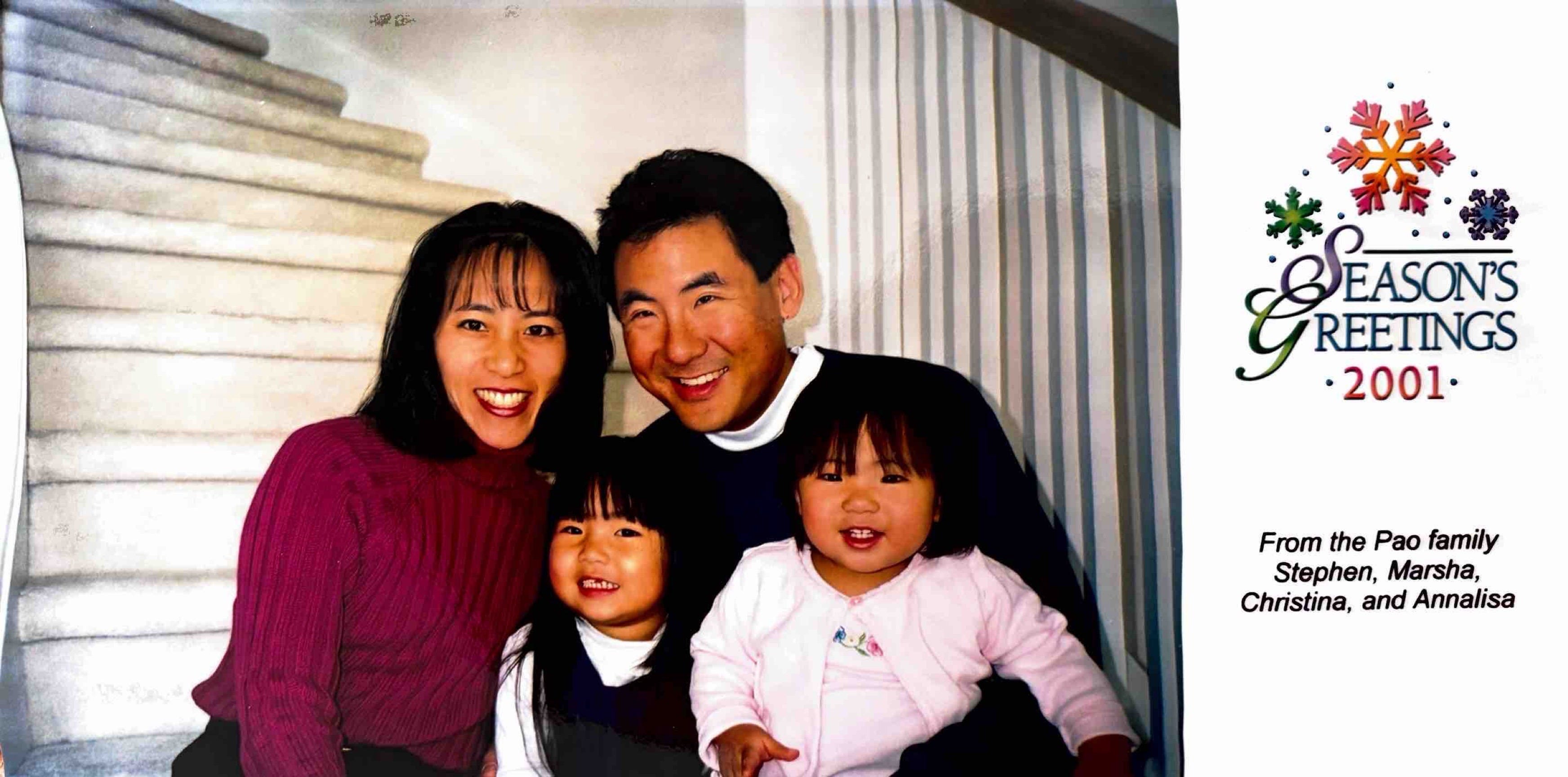
Rebuilding the relationship with Marsha’s parents played a large role in our decision to move back to the Seattle area back in 2001, shortly after our younger daughter was born. I was working through a genuinely stressful stretch at Latitude Communications, which is its own story, and I wasn’t spending the quantity time with our family that either of us wanted. Underneath all of that, we both had grown up with a different set of family rhythms and habits, and there were just some underlying issues we couldn’t fully describe at the time.
Still, Marsha and I both knew we needed a change. Moving to Seattle seemed like a good next step to get support from grandparents. So, we drove to Washington with our kids and our cat (Hank) in our minivan in March, 2001. Marsha’s dad ended up dying two weeks after we arrived. Our best laid plans to get support from grandparents turned into a period of family grieving.
Of course, the backstory here is that unbeknownst to Marsha (and her brother), Marsha’s dad had been fighting liver cancer and was refusing treatment. With the prospect of the family reuniting, he underwent his first chemotherapy treatment which his body was too weak at that point to tolerate.
The death of Marsha’s dad didn’t create the friction in our marriage but rather helped bring forward our different rhythms to the surface.
Marriage counseling begins
As we were starting to confront our own issues, Marsha wanted us to go into marriage counseling. She asked me to find a counselor, and I didn’t. Both frustrated and determined, Marsha went and started seeing one on her own. The counselor let her know that they could no longer move forward in the process without me, and that I had to join her. This wasn’t a proud moment in my life.
Still, I must admit that even though Marsha was frustrated enough to force the issue, she kept sending a consistent message at every step. She told me, in different ways many times over, that she loved me and that we were going to get through this together. At the same time, she made it clear she wasn’t afraid to make a change if I wasn’t willing to do my part. It wasn’t a threat as much as it was a clear intention on her part to do everything she could to make the marriage work, and she was asking me to do the same.
Marsha picked a really good counselor. She found someone that had experience working with men, including professional athletes from the Seattle Mariners and Seattle Seahawks. I’m not an athlete, so the sports connection itself wasn’t the point. To me, it demonstrated that Marsha was willing to look outside of herself to find someone that would work for me, too. That said, she still tried unsuccessfully to start marriage counseling alone.
This process started a few months after her dad’s death, once the most immediate grief of his passing had settled a bit. Still, I felt we were living in its wake. We probably went for a couple of months in total. Marsha’s mom watched our kids for us every time we went, which was just one of many small gestures from her side of the family. I must admit that I feel like Marsha’s mom (now deceased, too) and her brother (very much alive and kicking!) have gone out of their way to be good to me since the time that Marsha’s dad passed.
What we learned
Even though Marsha and I had very different rhythms, we always talked about everything. The therapist very fairly noticed that Marsha and I generally agreed on the facts and circumstances for any incident that we described. Where he helped was explaining why we came away feeling very differently about these incidents.
Marsha had more than 25 years of relationship and experiences with her own family before we ever got together, and I had that same span of years with mine. Neither of us could set that history and background aside just because we’d become a couple. The therapist told us that the two top issues he saw for couples at our stage were money and in-laws. We didn’t have money issues, so our conversations really focused on families of origin.
A key takeaway for me was the need not only to prioritize my own family (Marsha and our kids) over my family of origin, but also to do my best to help Marsha to feel that way. When I expressed the need to prioritize my own family with my parents, they largely agreed in principle. Still, even with this understanding, they didn’t always demonstrate that understanding in how they acted afterward. Even with the best intentions, old habits can die hard.
The tools that stuck with me
Given that Marsha and I were largely aligned in our objectives, the therapist was able to offer several tools, which I remember today.
A really useful one was rephrasing from “if” to “when.” Instead of spending our energy worrying about hypotheticals, we should work together on our responses. For example, instead of worrying what will happen IF a bear attacks us in the woods, we should collaborate on how we will respond together WHEN the bear attacks. Of course, the bear attacks were an analogy for unexpected situations with our families of origin. Shifting our focus to working together on a response over one-sided and endless worrying was a positive step!
Another useful tip was about our use of pronouns. Whenever possible, we should prefer the first person inclusive over the second person. For example, when a situation arises, instead of asking “what are YOU going to do about it?”, ask “how can WE solve this together?” There’s a lot of wisdom in this, particularly because each of us had established our own patterns in handling situations that could use some collaboration and refinement. Again, working together was a positive motion.
The last one was about bringing up past issues. The analogy here was a coffee table book. It was OK to take a book off the shelf to the coffee table, open it, look at it, discuss it, and eventually put it away. It was even OK to take it down again from time to time. What we didn’t want to do is leave the same book open on the coffee table indefinitely.
What lasted, and what didn’t
The shift from worrying about the potential of a situation to working together on a response was effective and got us through short-term situations in those early years. The tool became less relevant over time.
Probably the most lasting tool was the pronoun switch, or remembering to say “we.” We still remind ourselves of this today, and it really stuck with us. It’s why I used this tip as the title of this post.
What those initial tools couldn’t do for us was resolve feelings that had been sitting unprocessed for decades. Marsha can recall things that happened 30 years ago as clearly as if they happened yesterday. The situations themselves moved forward and got resolved logically at the time. The feelings underneath them didn’t. So, while she dutifully put the coffee table books back on the shelf, there was a backlog of books that she wanted to reopen.
That gap is what sent us back into counseling decades later, in our fifties. That round was less about pronouns and more about learning to ATTUNE to each other, the Gottman method I wrote about in a prior post (“Disrupting Patterns of Disappointment”), and about refining how we communicate with each other. (For more context, see my post about alexithymia.)
The first round of counseling was exactly right for the stage of marriage we were in, as it was very solution focused. The next round really had to explore more of the “why.”
Passing it forward
I’ve told part of this story before. In an earlier post (“Why am I willing to be so open?”), I mentioned a friend whose pastor told him that God makes people attracted to partners that “rub each other the wrong way” so the two of them can polish each other into two smoother stones. I said then that the story helped me put our own marriage counseling in context, and that there was more to tell later. (That later time is now!) We tell our girls that friction is not a bad thing in relationships because it helps people navigate to the other side.
Being open about our experiences with marriage counseling, and about my own reluctance to do it, has mattered to me well beyond our own marriage. During retirement, one person took me out to lunch specifically to thank me. Years earlier, on a business trip, I’d shared my own experience with marriage counseling with him, and it helped destigmatize the idea for him. Since retiring, nobody has ever taken me to lunch to thank me for the great products or business plans we made together while working years ago. I’ve just found that sharing life challenges with each other has a more lasting impact than past business accomplishments!
I later watched a video of Alain de Botton (“Why you will marry the wrong person - Google Zeitgeist”) making a related point that a successful marriage isn’t about finding someone without flaws. It’s about learning to negotiate the flaws each partner brings. Basically, de Botton was saying the same thing that my friend’s pastor told him. I mention that because I feel we’re all sort of living the same experience in private.
An ongoing journey
What we learned in our thirties got us through raising our families. As we became empty nesters, we realized that what we started wasn’t completely resolved by our fifties. Those of you following my health journey know that I’m about to undergo a set of procedures that will put me in recovery for a year to hopefully gain another twenty. What new learnings are ahead of us as we approach our seventies?
That question feels more real to me now than it used to. If this next round of treatment goes the way we hope, Marsha and I could have another twenty years together that might not have otherwise been available to us. Most couples historically didn’t get that many healthy decades together or the intention to keep growing their relationship. We are a bit like a mouse in a maze with few examples in our lives to follow, but we’re learning.
Fabulous! I love the “when” instead of “if”, and “we” instead of “you”. Sometimes I feel like all of us need counseling even when we don’t have issues etc.