


Editor’s Note: This is the second of two posts about leaving Silicon Valley in 2001. The first, “How my first three jobs wore on me (Part 1 of 2),” covers what actually wore me down at Oracle, Visioneer, and Latitude. This one picks up from there, the decision itself, what it took to actually leave, and what eleven years in Silicon Valley came down to financially once I did. What the move then cost us personally, and the marriage counseling it led to, is its own separate story, told in “Remembering to Say We” two weeks ago.
By early 2001, all of my first three jobs after graduating had added up to the same feeling. I didn’t feel like I was succeeding at anything.
A holiday visit
As Latitude was unraveling, I was working long hours and traveling frequently for work, which meant I wasn’t spending much time with family. During a holiday visit to Marsha’s family in Bellevue (a suburb of Seattle), I watched my father-in-law riding down the hill in front of their house in a wagon with my older daughter, and something just struck me. I didn’t immediately piece together how everything would unfold, but intuitively, I saw a glimmer of a potential improvement to our family life.
Up until then, my whole adult life had run really according to a pretty standard playbook. Go to a good college, get a master’s degree, and then take a job at a reputable company. From there, join a startup to get experience, and maybe take one of them public.
By early 2001, I’d been executing against that playbook. Latitude had gone public two years earlier, and I was an officer of the company. I still didn’t feel like I was succeeding at anything, and I didn’t have an idea of what the next plays would look like beyond that.
My own father had worked long hours and traveled constantly too, not so different from how I’d been living myself. Neither of us was ever really absent. We just weren’t reliably home for dinner, or for the smaller, ordinary moments that make for closer family relationships. That was the world I knew.
So watching my father-in-law with my older daughter didn’t necessarily help me rewrite a whole plan, but it did spark an intuition, not fully formed yet, that being closer to Marsha’s family in Seattle could actually make a difference. We decided to move.
Getting ready to go
Once we made the decision, Marsha ran with all the logistics, the same way she ran most of the household by then. We joked that if I were the CEO or CFO of our family, Marsha was the COO, though operations was by far the biggest job with two small kids in the house. The division of labor was probably never fair, and it probably isn’t even today. This is just the rhythm we settled into.
Beyond the child rearing duties, Marsha handled all the little construction issues with the builder of the brand new home we bought in 1998, as well as project management for the landscaping and deck we’d built out back. She handled all of our travel planning, too.
So, when the move itself came up, Marsha took it on the same way, without either of us really discussing who would do what. She got our house on the market, handled the move, and flew up to Seattle with the kids to scope out our top housing choices. I just flew up later to weigh in on the final decision.
A company shaped exit
When I told the Latitude CEO that I wanted to move, he also took it in stride. Instead of treating it like a resignation, he immediately moved into solutions mode. He acted as if I was just going to keep doing my job from the Seattle area instead of Silicon Valley and had our office manager find a cool office space in Bellevue to work out of.
There’s actually a detail here that wasn’t public knowledge at the time. Leaving Silicon Valley was my choice, but how I actually left Latitude wasn’t. The company was recruiting a VP of Sales at the time, and as a public company, they didn’t want to be seen publicly hiring both a VP of Sales and my replacement for VP of Marketing at the same time, particularly when the stock was already in the toilet.
In March 2001, when we moved to Newcastle (just six miles from Marsha’s family home in Bellevue), I kept running the Marketing group under a title that was really just cover. We changed my title to VP of Corporate Development, with the stated purpose of strengthening our relationship with Microsoft. I think at least some people might have believed this because some of the most valuable work I was recognized for in the company was developing partnerships with Microsoft, Lotus, and Cisco. These relationships probably mattered more to where the stock traded than what I did functionally inside of Marketing and Product Management itself.
In the end, I stayed at Latitude until August 2001 when they found my actual replacement.
Split in two
Writing this in reflection twenty five years later, in a post-pandemic era, “remote” really understates what those five months from March to August of 2001 actually looked like. While my home was in the Seattle area, I was down in California pretty frequently, sitting in the same face-to-face meetings I would have been in if we’d never moved at all. The whole stretch felt like a countdown to me. It really was less a start of a new life and more of a wait for the old one to actually end.
On the days I did work from the Bellevue office, it felt like home. I shared a suite with Latitude’s application engineer for Microsoft as an enterprise customer. She fed my caffeine habit every morning, dropping a venti iced mocha from the Starbuck’s downstairs on my desk while I was already on my morning conference calls. I started leaving a five dollar bill out for her to pick up when she got in. It became its own small ritual, when I did get to be in town.
On the other days, there wasn’t a Seattle life to speak of. I was living out of hotels, splitting time between the Santa Clara and San Francisco offices, with the occasional business trip layered on top.
Somewhere in the middle of that countdown, I picked running back up. Shortly after the wind-down actually ended that August, I ran my first three marathons, Portland, Silicon Valley, and Seattle, three in three months. Today, they call that a “marathon maniac!”
The financial disappointment
Money tells a different story depending on which of the three companies I’m talking about.
At Oracle, I was in the employee stock purchase plan the whole time, buying discounted stock through payroll deduction and selling it off as I went. The stock went up about 10X from its low in October 1990 to when I left in October 1993, and I actually got to enjoy those short-term cash infusions at the time instead of just watching a number move on paper.
Visioneer went public after I got laid off, while I was already at Latitude years. I’d exercised my options on the way out the door, and separately I had put money in as a Series B investor during that funding round. Both of those moves worked out. Ultimately, the company sold its hardware division to Primax (for which I got cash) and reorganized its software assets by merging with Xerox’s OCR division, converting my Visioneer shares into ScanSoft shares, which also did OK.
Latitude was different, and it’s the one that actually mattered to me the most. I never sold much of that stock along the way. I cashed out my very first grant, back when I was hired as a product manager, to pay for the landscaping on the first house we had purchased in 1998. Almost everything I was awarded after that through promotions, I just held onto. By the time the stock hit a dollar, most of those later stock option grants were. “under water.” In other words, they cost more to exercise than they were worth in the public market.
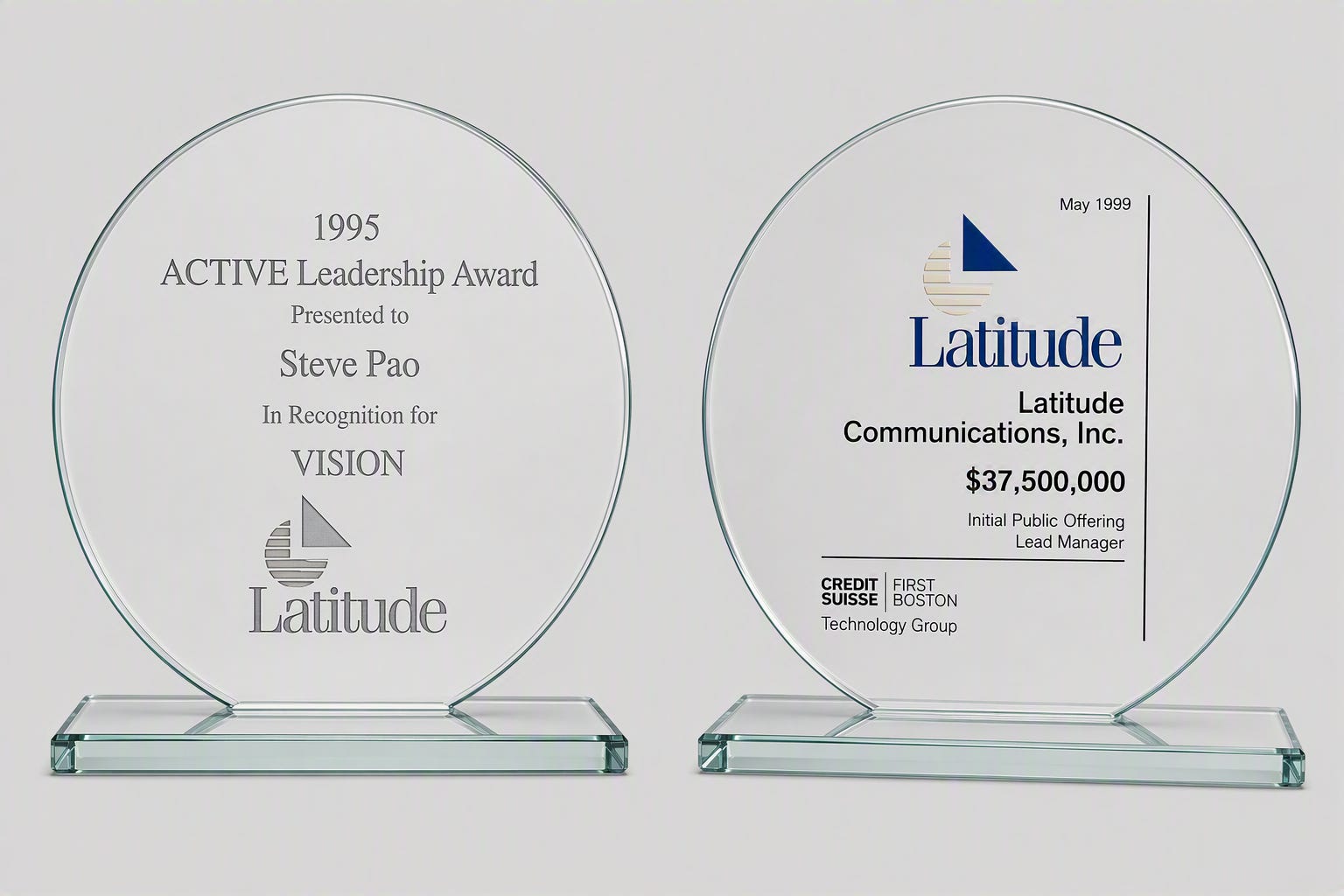
The only options that still had any value when I left were from a leadership award I’d won early on, back when I was still an individual contributor and eligible for that kind of award. When I finally left that August, I exercised the options from that small award and sold the same day. The company I’d worked hardest for, and cared about the most, is the one that handed me a check for about $900 on the way out.
So, as stated in my previous post, I was already getting frustrated and I hadn’t moved the industry forward. The companies I was with had some short-term successes, and I suppose I did OK, with the insult of a $900 check notwithstanding.
Still not addressing the bigger issue
However, underneath all of this was the same thing I’d felt watching the wagon scene. The playbook had run out and I didn’t have a next one written. I still didn’t have words for it. I just felt the urge to leave Silicon Valley. At least for a while.
I’ll leave the story here for now and come back to it in September. The Seattle years turned out to be far less straightforward than I expected, with two startups, an unplanned stretch away from work, and a consulting experiment along the way. Until then, I’ll continue with my regular posting schedule and circle back when it’s time to pick up the thread again.