


Editor’s note: Unlike a lot of my journaling which covers the personal tech side of AI, this piece goes into a bit more of the business side of AI because I’ve recently been in so many conversations about this.
Recently, I came across a drawing comparing organizations before and after AI. I don’t know who made it originally, and I haven’t been able to track down the source since then.
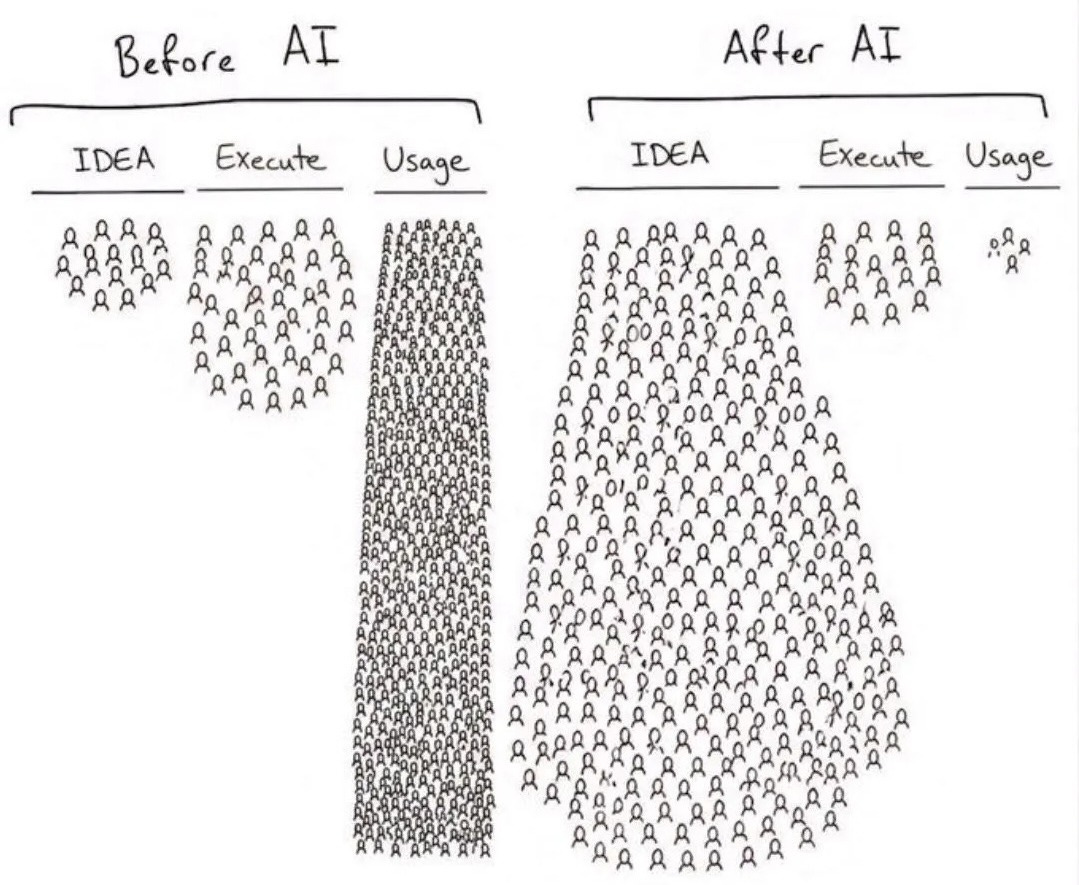
The drawing uses three columns: Idea, Execute, and Usage. Before AI, Idea and Execute are both fairly small, and Usage is the largest column by a wide margin, a big funnel of people actually using what got built. After AI, Idea explodes, Execute grows only a little, and Usage shrinks down to almost nothing. Some might read that as good news, since more people are generating ideas. However, I believe the real point lies in the shrinkage of the Usage column.
Some of my discomfort comes from what I’ve been seeing in my consulting work since retirement. The companies I work with are rolling out Claude, ChatGPT, and similar tools broadly, and they’re pushing employees to go from AI-assisted to AI-native. In practice, that shift means a salesperson who used to spend a day assembling a custom proposal can now generate one in a few minutes, and a support engineer who used to escalate an unusual case to a senior colleague can generate a full troubleshooting plan on their own in the same amount of time. I get the motivation. AI can help people write faster, analyze faster, research faster, and communicate faster. When used well, AI removes a lot of low-value work. I’m not skeptical of that promise.
The deeper issue is what that AI is actually drawing on. Most companies hand employees a general-purpose assistant that has read the open Internet, not the narrow set of things the company has actually learned about its own customers. Even when a company does point its AI at internal documents, in my own consulting work I have yet to see one with a clean, canonical body of material an AI could reliably draw from. What exists instead is usually a mess of outdated decks, internal debates nobody resolved, and practices that some people follow without the reasoning behind them ever being written down. So the AI can produce something confident and well-argued without ever touching what the organization has actually validated works. That gap between how confident the output sounds and how little of it has been tested against reality is exactly why so much of it never turns into real usage, whether that means a pitch that lands, a deal that renews, or a process that actually gets adopted.
What I keep noticing is that in all these discussions about making individuals more capable, there’s a lot less discussion about how organizations actually learn. That might sound like an odd thing to worry about, since companies are made of individuals, so if the individuals get more capable, shouldn’t the organization too? The more I think about it, the less sure I am.
What changed my thinking
One thing I’ve come to appreciate over my career is that successful organizations rarely win because they have more ideas than everyone else. Most organizations already have plenty of ideas. Product teams have them, engineers have them, salespeople have them, customers have them, and executives have them. Most companies have far more potential opportunities than they have time, money, or attention to chase. The hard part was never generating possibilities. It’s deciding which ones deserve attention, and then actually learning from how they play out.
That’s where playbooks come in. For most of my career I thought of a playbook mainly as an instruction manual. Sales playbooks told salespeople what to do, support processes told support engineers what to do, and marketing frameworks told marketers what to do. I don’t think that’s the important part anymore. I think a playbook is better understood as a common learning surface.
Picture a sales org with a hundred salespeople, all pursuing roughly the same customer profiles, using roughly the same messaging, and following roughly the same process. Now the organization can learn from all hundred at once. One seller keeps running into the same objection, another notices a value prop that resonates unusually well, and a third finds a customer profile that converts better than expected. None of those observations mean much on their own, but they become valuable because they’re all happening against the same shared framework. SalesOps can see the patterns, product marketing can refine positioning, and leadership can adjust priorities, so the next version of the playbook reflects what the org learned. What scales isn’t the playbook itself. It’s the organization’s ability to keep improving it.
The part that worries me
Once I started thinking about playbooks that way, AI adoption looked different to me. Most of the conversation is about what one person can do with a tool. A salesperson generates a new pitch, a marketer builds a new positioning framework, a support engineer designs a new workflow, and an account team spins up a customized engagement model. A lot of that output is genuinely good, and some of it is even better than what already exists. That’s not really what worries me.
What worries me is that every one of those individualized alternatives creates its own separate learning loop. If a hundred salespeople are refining one playbook, the organization learns from a hundred salespeople. If a hundred salespeople are each refining their own version, everyone may still be learning something, but the organization has a much harder time turning those individual experiences into collective knowledge. Outcomes get harder to compare, feedback gets harder to aggregate, and patterns get harder to spot. Everyone is learning, but they’re not learning together.
None of this means individual variation is the enemy. Reps have always improvised, and some of that improvisation is exactly how playbooks get better over time. The old kind of improvisation was slow and visible enough that sales management could see it and weigh it against results. What matters isn’t whether someone deviates from the playbook. It’s whether the organization can see the deviation and measure what happened because of it. AI makes deviation cheap and easy to produce, and invisible unless someone builds the system to track it.
The phrase that keeps coming back to me is that everyone ends up “choosing their own adventure.” That sounds empowering at the individual level, but I’m not convinced it creates any leverage for the organization. It’s a smaller version of the same thing the drawing showed me. A lot more ideas, and not much more that actually gets used.
The proposal that should never have existed
One example from my own consulting work makes this concrete. In the B2B sales motions I tend to see, a good playbook usually pushes reps to identify the real buying committee before treating a deal as qualified. That discipline exists for a reason. Deals that go through real discovery and land the right stakeholders are more likely to have the internal support needed to renew and expand. Reps under pressure to hit a number do not always have that patience. With AI, it becomes easier to build a narrower and more urgent value proposition around whoever in the account is willing to move quickly, skip the harder discovery work, and still get something signed. The deal may count toward this year’s revenue, but if it was sold without real consensus, it may be much less likely to renew or expand. In the worst case, the short-term booking creates a larger long-term revenue problem than it solves.
That’s the realization that changed how I think about this. Sometimes the problem isn’t that an AI-generated proposal is low quality. Sometimes the proposal should never have existed in the first place, because the organization already learned that a deal built this way doesn’t hold. AI just made it easy to route around that discovery process and produce something that looks like a win in the moment. The rep’s number for the quarter goes up. The company’s actual revenue the following year may not, and this is the same pattern the drawing depicts, showing a lot more activity up front and a lot less that survives to be used later on.
Why this reminds me of product marketing
Working through this, I kept circling back to a piece I wrote recently about separating meaning from voice in AI content systems. The idea there was that product marketing should own meaning, brand should own voice, and AI should act mostly as a renderer. At the time I was thinking about content quality and semantic consistency. Looking back, I think I was really writing about organizational learning.
If product marketing figures out something important about positioning, I don’t want every salesperson, agency, regional team, and demand-gen team inventing their own version of it. I want that learning captured somewhere shared, adapted appropriately by brand, and given context by regional teams where it’s needed, with AI helping to distribute it quickly and consistently. In practice, that might look like this: the messaging comes from product marketing, the voice comes from brand, industry-specific information comes from segment marketing, and reps add their own context, account notes, and what they actually know about the buyer. What reps aren’t doing is inventing new messaging or a new business case from scratch every time. AI’s job in that model isn’t to help each rep write something new. It’s to render the shared assets into something personalized, flag when a deal has drifted away from them, and tie that drift back to whether the deal actually renewed. Product marketing still does what product marketing does, brand still does what brand does, and segment teams still do what segment teams do. AI just helps the learning move through the system with less effort and less distortion, while also helping the organization see when downstream motions have drifted away from the shared model.
I think this is where some organizations are leaving value on the table. The highest-leverage use of AI probably isn’t helping every employee build their own version of the strategy. It’s helping the people responsible for the strategy learn faster from the people out there executing it.
The question I keep coming back to
The AI conversation usually centers on individual productivity, because those gains are easy to see. Someone writes faster, someone researches faster, and someone generates more options. The question I keep asking myself is different. Does the organization learn faster? Does feedback from the field actually make it back to the people responsible for improving the system? Does the next version of the playbook get better because of what everyone learned together?
Those questions matter more to me than whether any one employee can crank out another deck or another proposal. I don’t think organizations scale because everyone invents their own playbook. I think they scale because a lot of people help improve the same one. The drawing that started this whole train of thought put it more plainly than I can. More ideas without more usage isn’t progress.
AI disclosure: I used AI tools during the drafting and editing process to help clarify structure and language. All ideas, judgments, and final wording are my own.