


We sat down with one of our financial advisors for our regular quarerly check-in, and it turned into a pretty timely discussion. The purpose was to revisit our allocation of risk-controlled assets across our different accounts, including the ones they do not manage, to ensure we are holding onto sufficient cash and cash-equivalents.
Longtime readers may remember one of my previous posts “Retirement Portfolio Apologies” from two years ago, where I first wrote about sequence risk and the discipline of maintaining a reserve of cash and bonds to mitigate this risk.
This post is simply revisiting that same topic, this time reflecting the current economic environment.
The five-year rule
Our advisor simply wanted to refresh our memorie about holding onto roughly five years of living expenses in cash or bonds, separate from stock, private equity, and other “risk assets.” The point of allocating this way is to act as a buffer for market volatility.
The problem we’re trying to avoid is selling stocks to cover living expenses in a year that the market drops, say 30%. In that scenario, the loss gets locked-in. The decline in that one period then has a permanent impact because the asset base that could compound back when the market recovers shrunk in the process. As mentioned earlier, finance types call this a “sequence risk,” and they caution that it’s one of the more dangerous threats to a retirement portfolio. It is a timing problem, not a market problem. Forced selling during a downturn misses opportunities to participate in a follow-on market recovery.
A five-year cash and bond buffer can help to avoid this problem. If stocks fall, our strategy would be to just spend from the buffer instead of the stock portfolio, let the equity recover, and refill the buffer later after prices rise again. Rather than trying to predict a downturn, the aim is to simply remain indifferent when one happens.
The good news from our meeting was that we didn’t have to do anything. We came in about 1.7% overweight in risk-controlled assets relative to the target, which is close enough to just leave everything alone. We didn’t have to reallocate our portfolio, and this was just a sanity check. The more interesting discussion was related to why the advisor teams are doing this set of reminders with their clients like us right now.
The AI capex question
The finance community has been paying attention to the rapidly growing amount of capital currently being poured into AI infrastructure. For example, Apollo Global Management published a graph showing the high levels of AI investment as a share of GDP compared with the telecom buildout in the dot-com era.
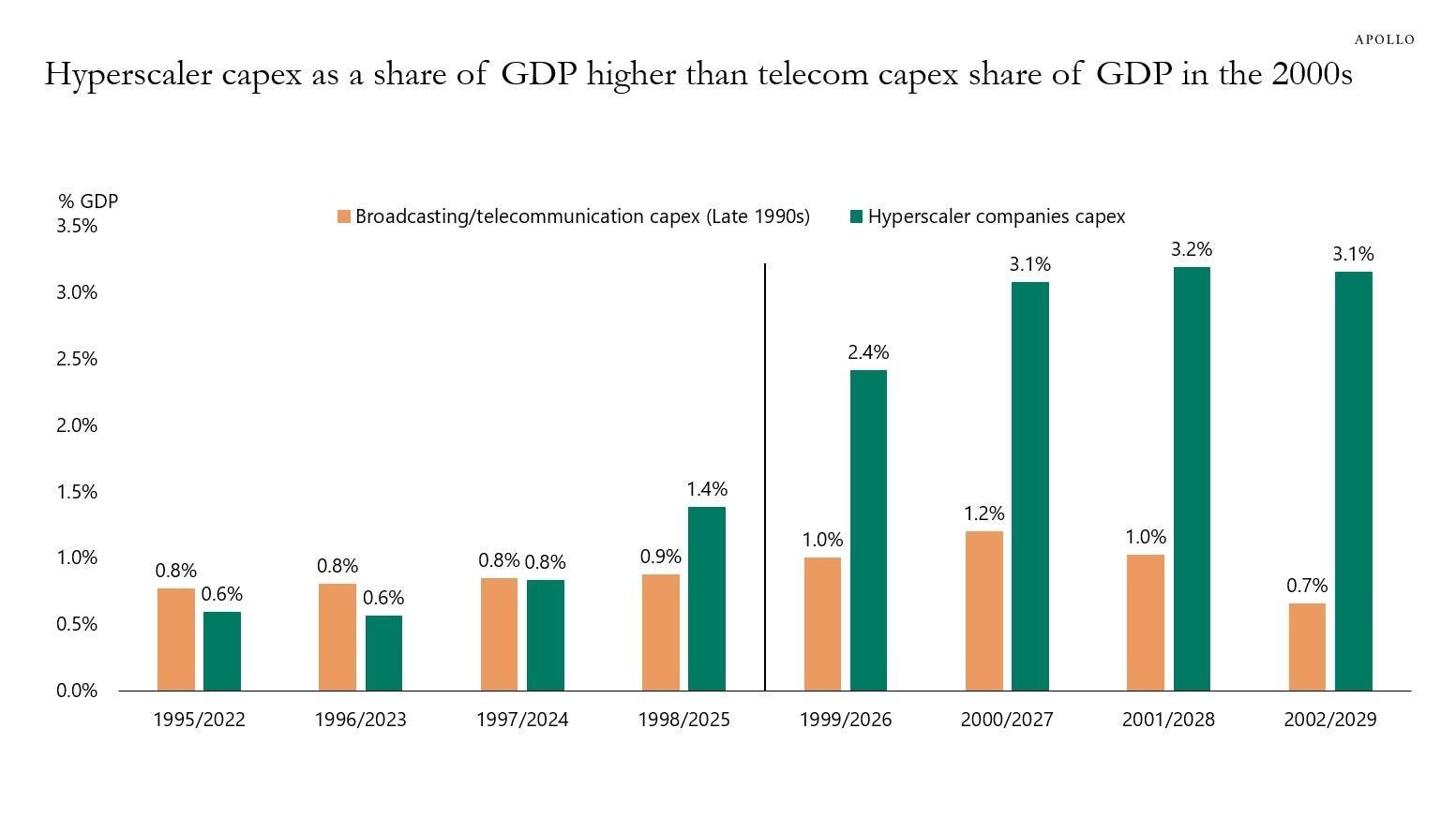
Of course, there is a real bull case for this buildout. The hyperscalers are generating revenue. Amazon is reporting triple digit growth in its AI business. Microsoft reported 123% growth in its AI business. Google’s cloud business is up 82%.
From an end customer perspective, there are also interesting data points. AI Business Weekly summarizes them, including quotations from Nvidia’s State of AI Survey, citing that 86% of enterprises plan to raise AI budgets in 2026. On average, AI now represents 18% of total IT budget, and that number is 25-30% in tech forward industries, such as finance and SaaS.
The honest tension among those watching this industry is that infrastructure spend and enterprise return-on-investment (ROI) are both trending upwards. The problem is that no one is claiming that the two are moving in step with each other. Today, the spend is ahead of the ROI. Even Amazon and Alphabet (Google’s parent) reported negative free cash flow in the latest quarter.
Of course, having spent an entire career in venture-backed startups, I’m personally familiar with forward-looking investment. The problem isn’t necessarily spending ahead of demand. The real question is always about timing and the speed of market adoption. Companies have to be careful to align cash burn with growth.
The financing problem
Oracle has been in the news because observers have been questioning this alignment of cash burn and growth. Oracle has been using debt to fund its AI capital expenditures. Its long term debt is now at $122.3 billion, and the company is looking to raise another $40 billion through additional debt and equity in fiscal 2027. About half of Oracle’s $638 billion in RPO (remaining performance obligations), comes from a single customer, OpenAI. If OpenAI ever struggled to pay its bills or elected to terminate early, Oracle would be stuck holding data center commitments it couldn’t easily exit. That’s not just a hypothetical anymore. The Wall Street Journal reported that OpenAI’s operating loss widened to $12.3 billion in the second quarter of 2026, up from $9.3 billion in the first, even as revenue grew to $6.7 billion. OpenAI’s losses are growing faster than revenue, at the same time as the revenue of OpenAI’s rival Anthropic, doubled to $11.6 billion and generated a small profit over the same period. S&P has downgraded Oracle’s credit ratings, and Moody’s has put a negative outlook on the company. All of this has caused Oracle’s stock prices to fall (down over 50% from its peak in September 2025), and its stock is sitting inside nearly every broad index fund, including ones we own (e.g., CUSUX, CMEUX, FXIAX, SPY, JTEK).
At a personal level, I see how Larry Ellison is likely just making yet another bold industry bet. At a much lower level, I had a personal experience with this when I worked at Oracle at the beginning of my career, from 1990-1993. In my group, our designs for Oracle Data Browser looked beautiful on the large monitors of a Sun workstation (1152x900) but were admittedly hard to use once we ported the product down to Windows 3.1 with its small VGA (640x480) or SVGA (800x600) monitor sizes. I vividly remember during one of our product reviews, Larry Ellison reassuring our team not to worry about it, as he firmly predicted that everyone would soon be using large monitors on Windows desktops, anyway. Directionally, he was right, but his prediction was a few years too early, as most customers ultimately waited to switch to 1024x768 monitors until they upgraded to Windows 95. This was a timing issue. His bet on AI could simply be another case of his making a call ahead of the market.
Beyond Oracle’s on-balance-sheet debt, Microsoft and Meta have chosen to finance their own AI infrastructure by leaning on off-balance-sheet SPVs (special purpose vehicles). These are joint ventures that carry the debt for the data centers while the parent company signs a long-term lease. A Wall Street Journal analysis reported on nine major tech companies that are now carrying about $3 trillion in these off-balance-sheet AI commitments. This figure triples what they report in disclosed leases and long-term debt combined, and it is growing far faster than their reported capex.
For example, Meta’s Hyperion data center in Louisiana is a campus the size of about 1,700 football fields, and the $27 billion in debt financing its construction does not appear on Meta’s balance sheet. A joint venture majority-owned by funds from Blue Owl Capital actually owns the campus, and a holding company raised the construction financing through a separate bond sale. Meta signed on as a minority partner and tenant, agreeing to an initial four-year lease with options to extend up to 20 years, and guaranteed it would make bondholders whole if it doesn’t stay the full term. Since Meta doesn’t consider that guarantee probable, none of it shows up as a liability on its books.
It’s not necessarily that off-balance sheet debt is safer overall. It just appears in the market in different ways.
Data center SPVs like this one involving Meta are funded using a blend of debt and private equity. If a data center customer can’t pay its lease and contracts are renegotiated, the parent company’s stock isn’t directly hit thanks to non-recourse SPV structuring. Instead, the loss hits equity investors first since private equity sits at the bottom of the capital stack, below the lenders. So, we’re directly exposed ourselves because we invest in data center private equity through KKR Infrastructure. We also invest in private lending funds, but none of the ones we’re invested in focus on lending to data center SPVs.
Also of note is Nvidia’s investment or funding arrangements with AI labs and cloud providers which use those funds to purchase Nvidia GPUs. The magnitude is large, with Nvidia reportedly allocating $750 billion to these arrangements. Some refer to this as “circular financing” which can artificially inflate reported revenue and mask true market demand. Some of this is par for the course. At Latitude, we did a version of it ourselves, arranging product swaps with a few vendors where each side bought the other’s offering instead of trading outright, so both teams could book it as top-line revenue. I’ll leave the names out, since some of those companies are still around. However, the sheer magnitude of the Nvidia allocations are making the financial communities take notice.
The difference from past infrastructure buildouts
Financial analysts often compare the AI data center buildout to the dot-com fiber buildout, which all worked out fine in the end. The dark fiber laid in the late 1990s sat mostly unused for years after the dot-com crash. A decade later, when streaming and cloud computing emerged, the fiber remained state-of-the-art and was there to fuel the next round of growth.
A very big risk factor is the depreciation schedule of AI silicon bounded both by physical degradation and economic obsolescence. The hyperscalers have historically used 5-6 year depreciation schedules for server hardware components. Given that Nvidia releases new chips every 12-18 months, what if the useful life turns out to be 3 years or less?
The rental market offers some indication of the shortened lifecycles for AI silicon. Observed market rates for renting Nvidia H100 GPU capacity fell from around $8/hour in 2024 to under $3 by late 2025.
The net is that AI silicon can’t sit unused for years without becoming obsolete. If the demand doesn’t show up in time for companies to service their debt with revenues, the assets just can’t sit patiently waiting for the next growth cycle. The hardware gets old, and the loans need to be paid.
So, this is where we get a timing problem. Over the long term, most analysts believe in the potential of AI. Microsoft, Meta, Amazon, and Alphabet (Google’s parent) will also likely come through fine either way, since each already runs a hugely profitable core business that can fund their AI bets, even if those bets can’t pay for themselves in the short term.
However, Oracle, OpenAI, and the smaller companies have much less of that cushion. And the question remains as to whether the impact will stay contained to these players, their lenders, and their investors, or if it spreads into the broader market. Will there need to be a market correction in the short term?
Personally, I’m not making any sort of market-timing call. Our financial advisor simply reinforced that it seems like a good time to validate that our own financial footing does not depend on being right about any of it. The five-year buffer is NOT a bet against AI. It’s insurance against the need to be a good forecaster in order to remain financially secure.
Staying invested anyway
None of this discussion changes the other side of the plan, which is to keep the rest of the portfolio invested in “risk assets” (public stocks, private equity, high yield debt, REITs, commodities, hedge funds, etc.). The uncertainty isn’t a reason by itself to go to cash more broadly. The cash buffer is what makes staying invested possible.
We’ve lived through a number of downturns, including the dot-com crisis, the Global Financial Crisis (GFC), and the 2020 pandemic. In all of these cases, we saw that the people who came out worse were those who sold somewhere near the bottom and got back in too late. It just turns out a large share of the market’s best days happened in exactly the moments when nervous investors might be sitting in cash.
At the same time, it’s worth being honest with ourselves here. During the dot-com crash and the GFC, I was still working, so we never actually had to withdraw from a shrinking portfolio to live on. During the 2020 dip, I was retired but the downturn was fortunately too short to test anything.
The next downturn might be the first test of this plan to utilize the buffer. The aim is to hopefully avoid selling at the bottom just to pay our condo dues and property taxes! (Brutal!)
My most vivid experience with this "circular financing" was at LATD, but it was right around the acquisition by Cisco. I was designing/building a massive MeetingPlace system for a top 10 SW company in the world. I was working closely with the Cisco Senior sales rep for this company. I found out that they purposely sold each other hundreds of millions of dollars of HW/SW, PER YEAR! The sales guys made bank, told me stories of taking CEO out on his boat, building a family compound in TX. It was a little different because both of those companies were highly profitable, had no financial risk. I've seen the dynamic many times in my career, although I've always called it Quid Pro Quo.
I loved the writeup on your financial checkup and the overall AI investment. Here’s what I am looking at .. The S&P 500 is up 80% (compounded) over the last 3 years (23,24,25) and another 12% this year …The numbers I’m looking at are the following: for the S&P500 the 10 year average (w dividends reinvested) growth is 15%, which is up from the 11% for the last 20 years and 10% for the last 30 … One of these days we will see a regression to the mean (ie massive drop and who knows for how long .. … during the 2008 financial crisis the SP500 fell 37% in one year, during the dot com bust it fell 9%, 12% and 22% from 2000 to 2002 making it a cumulative 38% drop over the 3 years !). With the US debt at 40 trillion and all the stuff going on in the bondmarket, I think the fall will happen soon, unless the president does something before the November midterms to temporarily juice up the market ….