


When Marsha and I retired in 2018, we had two daughters in college and our spending was at its peak. Our financial advisor at the time told us not to worry, because “these are just expensive years.” The idea was that once tuition, housing, travel, and other expenses related to having college-aged kids came to a close, our spending would settle into something more “normal.”
Those college-related expenses did end, and nothing we pay today comes close to those bills. Still, our spending never settled into the “normal” we expected. Instead, the expensive years feel less like a phase we got through and more like a permanent condition in a different shape.
I understand that some inflation is normal. Based on the Consumer Price Index (CPI), $1 in 1990 had the same buying power as $2.58 today, which amounts to an average annual inflation rate of 2.67%. Since retiring, I’ve believed that our costs as urban retirees grow much faster than that.
To test that belief against data rather than just grumble about it, I used AI to help me go back through eight years of tax organizers, condo budget packets, insurance forms, and travel receipts. It turns out my gut was right about two big things and mostly wrong about a third.
Condo dues
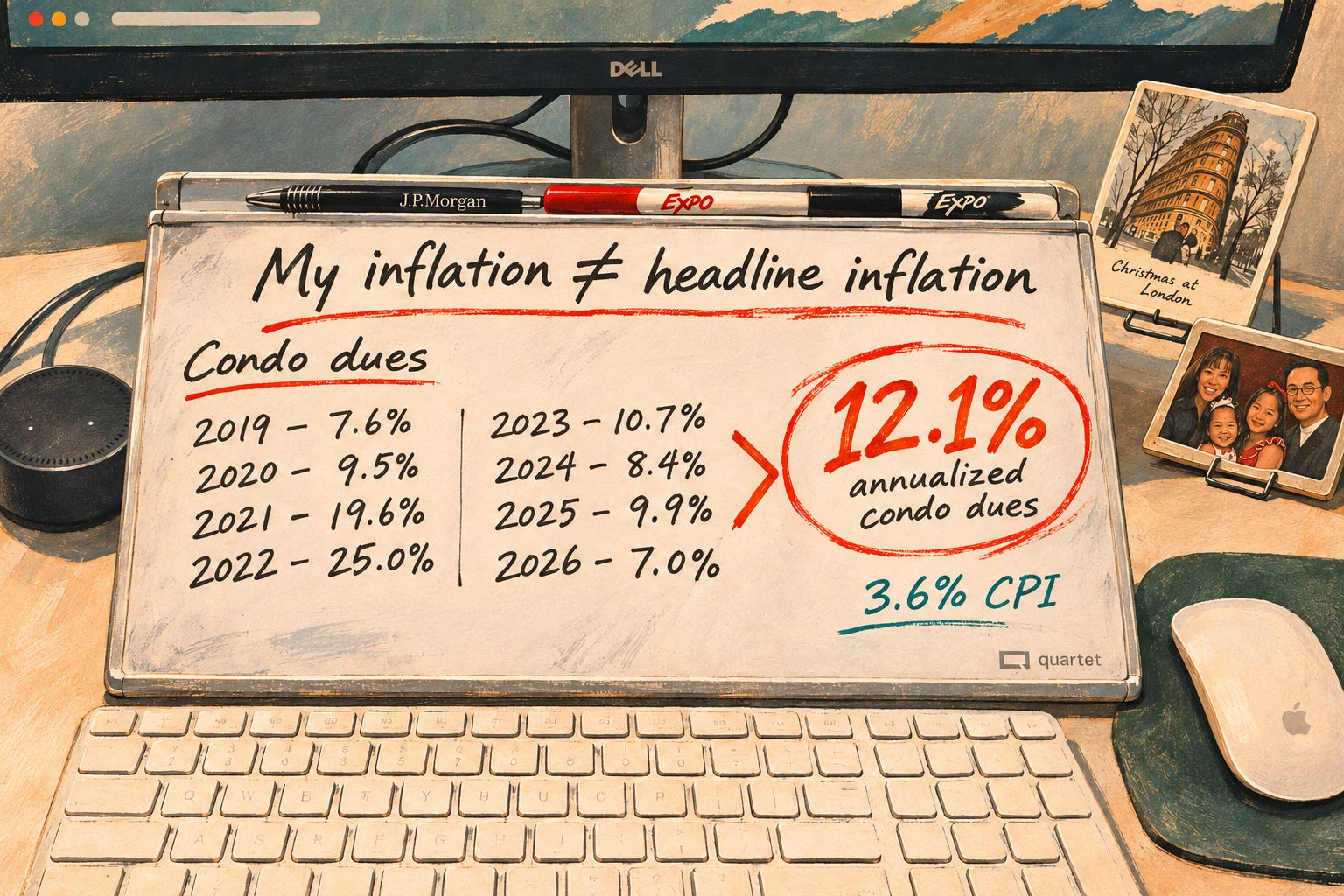
We live in a high-rise condo in Portland, and our regular monthly dues are now about two and a half times what they were when we retired. Over the same stretch, inflation rose about a third. Our dues outran inflation in every single year, including 2020, when the CPI rose by 1.23%, and our dues still rose almost 10%. The biggest jumps came in 2021 and 2022, at roughly 20% and 25%.
When our building opened in 2016, the developer set the monthly dues artificially low to make the units look more economically attractive. This practice is unfortunately common for new developments, and it has left many condo associations with insufficient reserve funds in later years. Our condo board acted on the data from reserve studies to raise our monthly dues and correct the situation. By 2022, the Surfside collapse in Florida was certainly on everyone’s minds, but for us the real driver was catching up on reserves that should have been collected all along.
We’ve also seen increases from the ordinary costs of high-rise living. Last year, our building’s property insurance alone went up by 15%. Even municipal utilities went up in price. For example, water rates went up by 8.1% this year. On top of all that, our building funded a construction-defect claim and replaced its HVAC system, involving special assessments for legal fees and to begin the replacement project while the claim was still pending. The claim has since been resolved, so I’ll save those stories for another post.
None of this is a complaint about where we live. I love urban living and our condo community. I would much rather pay dues for commercial-grade HVAC, water heating, and a professional staff than take on do-it-yourself home projects or manage a constant string of contractors. I once described our mortgage interest, property taxes, and condo fees as a very high rent to live in this part of town, and I still think of them that way. The dues buy a way of life we genuinely enjoy, even if the price of that life keeps climbing.
Health insurance
Because we retired well before Medicare age, Marsha and I buy our health insurance on the ACA marketplace, which I wrote about in an earlier post. When we moved to Oregon at the end of 2018, our Bronze plan for the two of us cost just under $1,000 a month. In 2027, the equivalent plan will cost $2,380 a month, a 37% jump from this year alone. I went into the reasons in The Double Ten Grab Bag, but the short version is that the enhanced ACA subsidies expired, many healthier people dropped coverage, and the insurers that remain are pricing for a sicker pool of people.
The coverage is also getting thinner. Readers of this Substack know I have no shortage of health issues, so I hit my out-of-pocket maximum every year. That maximum is going from $7,500 to $12,000 in 2027. When combining my out-of-pocket maximum with our premiums, our healthcare costs have more than doubled since we retired. Next year alone, we project a 43% year-over-year increase.
That said, I’m happy with our insurance itself. With as many health issues as I have, our insurer hasn’t denied me any coverage, and the company has been good to work with.
Travel
I fully expected travel to be the third part of this story. With this year’s jump in jet fuel prices tied to the war with Iran, I expected that my receipts would back my assumptions. They actually didn’t.
A typical nonstop round trip between Portland and San Francisco costs only about 15% more than it did in 2018, which is less than inflation, and our economy fares to Europe have been roughly flat. Nationally, airfares barely moved until this year’s spike.
What changed was not the price of a ticket but why we travel. Since retiring, nearly all of our trips have been built around family milestones, like graduations, our older daughter’s wedding, and Christmas in London with our son-in-law’s family. Those trips come with fixed dates, and we’ve often chosen to fly nonstop, which costs more than chasing the cheapest itinerary.
The past couple of years have added another kind of trip. Unfortunately, we’ve been to funerals and memorial services in Southern California for my cousin, for the mother and later the father of a college friend, and for the father of a friend who is also a close neighbor here in Portland. I made the trip on my own for my college friend’s father, and again to Baltimore for the mother of another college friend. Most recently, Marsha and I went to Long Island for the funeral of my friend Elliot, which I wrote about in The Double Ten Grab Bag. I feel lucky that we’re able to be there with and for the people we love, and that matters far more to me than what the tickets cost. It’s also true that nobody shops for a deal on trips like these, since the dates aren’t ours to choose. I suspect these last-minute trips make travel feel so expensive to me even when the receipts comparing like-for-like trips say otherwise.
The big-screen TV
I know that plenty of things have gotten cheaper. A big-screen TV costs a fraction of what it once did, but Marsha and I still watch the same one we bought in 2016. It works just fine. The CPI measures a basket of goods and services for an average household, and our basket as urban retirees looks nothing like average. Housing and health insurance make up a huge share of our spending, and those are exactly the categories that have outrun inflation, while the cheaper gadgets that help keep the official number down barely show up in our budget. In a sense, we have our own personal CPI, and it has been running a lot hotter than the one in the news.
I casually floated this idea at a rather bougie JPMorgan dinner, where Marsha and I somehow ended up at a table with some of the bank’s most senior people. My theory is that we were invited because we live downtown and someone far wealthier canceled at the last minute. When I mentioned our personal CPI, they agreed with me right away, and then pointed out that policy isn’t set on anyone’s personal CPI. Touché.
Funding the expensive years
The core of our portfolio, the part we draw from, tracks similarly to a balanced 60/40 mix, and it has done OK. The long-term plans our financial advisors have done since we retired have assumed general inflation of 2.4% to 2.6% a year, pretty consistent with the average inflation rate since 1990, and Fidelity’s planning tools use a similar 2.5%. Our personal CPI has been running well above that. So far, strong market returns have covered the gap, but I’d rather not count on strong markets forever.
Covering our costs from the portfolio also meant some sizable withdrawals, and I never liked the idea of selling equities to fund our lifestyle. It seemed to invite sequence-of-returns risk, the danger of being forced to sell during a downturn early in retirement. Every sale was also a taxable event, which meant selling more than the cash we needed just to cover the taxes. We still sell some today, but I wanted that piece to be smaller.
So I did what a retired techie tends to do and treated it as a cash flow problem rather than an investment problem. Part of the answer has been consulting. The other part has been a small portfolio of private construction loans funded by lines of credit, where we keep the difference between what the loans pay and what we pay to borrow, and each loan makes a monthly payment much like a paycheck. Together, they now fund some of these rising costs, and our withdrawal rate hasn’t really crept up as a result. I’ve written about the lending in Messy Portfolio Admissions and What Real Data Does to Vibe Coding.
Looking back, our advisor wasn’t wrong that the college years were expensive. What no one told us at the time was that every year after would be expensive too, but for different reasons. The college costs had an end date, but condo dues, health insurance premiums, and plane tickets to be with people we love don’t, and I wouldn’t give up any of them. The expensive years, it turns out, are simply the years.
AI disclosure: I used AI tools during the drafting and editing process to help clarify structure and language. All ideas, judgments, and final wording are my own.
Great read and on point. Our condo fees have doubled also, and shrinkflation is there as we get less out of it. I am on cobra now but will move to ACA in June. Travel is a big expense for us, and that inflation is much bigger than CPI. We can afford it but we don't eat out as much as the quality isn't worth the cost in most cases. We have stopped buying wine also at restaurants as it doesn't feel worth it. Europe yes we get the wine there.