


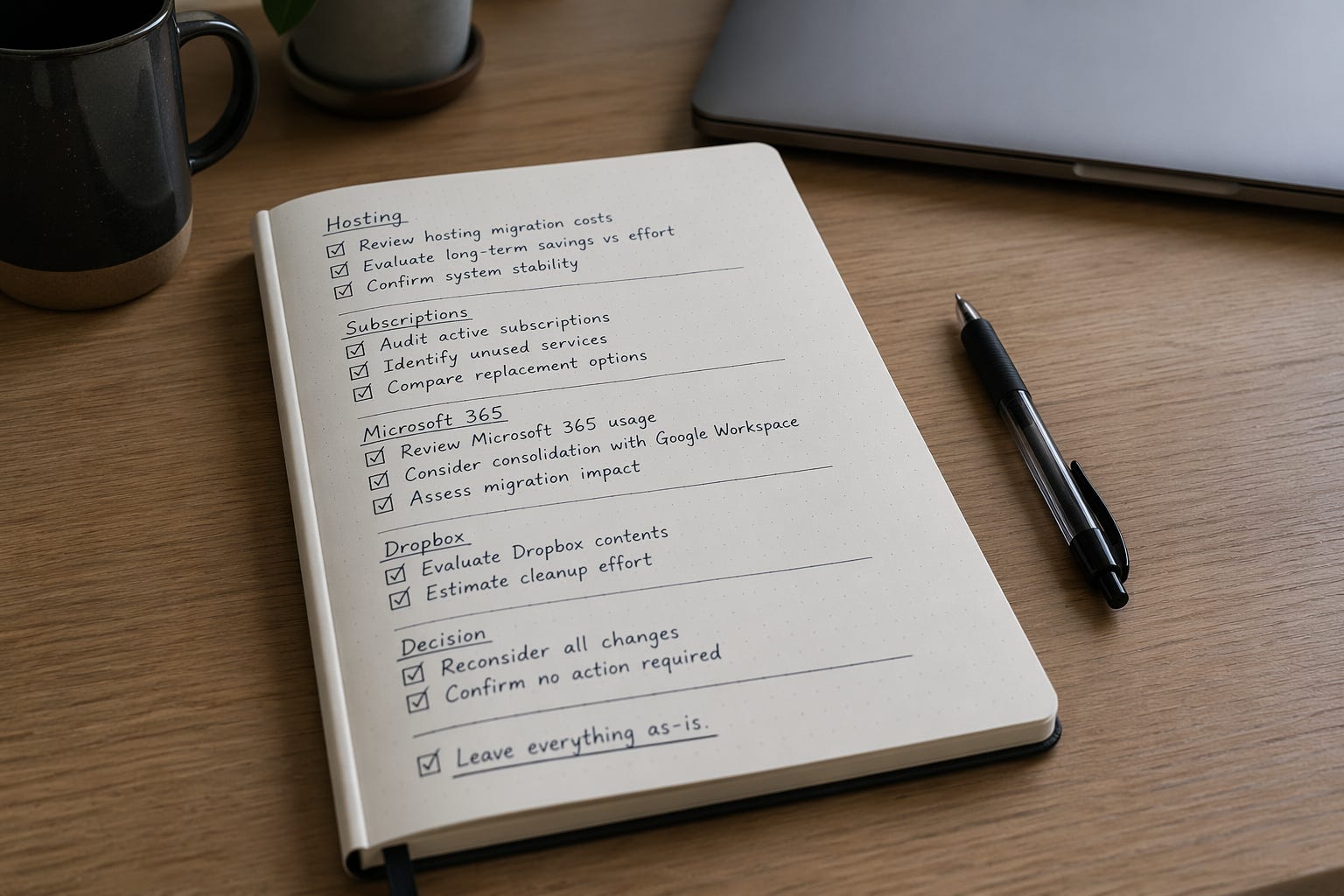
This is Part 2 of yesterday’s post. I split one long piece into two for readability and am releasing them back-to-back. Yesterday was about what I built. Today is about other stuff I’ve been poking at in retirement, and what I decided to do (or not do) about it. I am not planning to make a habit of showing up in your inbox twice in one weekend.
Yesterday, I wrote about rebuilding my web hosting setup from scratch. Today, now eight years into retirement and still figuring it out, I want to put that project in a wider context. It turns out it was just one of several technology decisions I’ve been examining in retirement. Having the time to look at things is one of retirement’s gifts. The judgment to leave well enough alone is apparently not included.
Leaving things alone intentionally
Not everything I’ve examined has led to action. Some things I’ve looked at clearly and chosen to leave exactly where they are. I am choosing to take credit for this.
I’ve had Microsoft 365 since before it was Microsoft 365. It started in late 2005, when I took a job at Barracuda and needed to learn Exchange administration to understand the customers and the technical space. So I stood up an Exchange Server on Windows SBS at home, with my server living in the garage. (Marsha had some thoughts about this and our sky-high California energy prices that I will not be sharing here.) When our customers started migrating to Exchange Online around 2011 or 2012, I migrated everything to the cloud and started another subscription. That was over fourteen years ago.
What started as email is now a lot more, and most of it I would not know how to reconstruct. Last year I went looking for a video a friend had shared with us years ago, found the email, clicked the YouTube link, and discovered the video had been taken down. The email was the only proof it had ever existed. That is a small example of a much bigger reality. We live in an urban condo with no file cabinet, and everything that arrives on paper and matters gets scanned and lives in OneDrive. Tax documents, insurance forms, things mailed to our address for our adult kids, and even Marsha’s recipes have all ended up there over fourteen years. The built-in search reads the scans, so finding anything takes seconds. I looked at this subscription and did not touch it.
There’s also a Google Workspace account I’ve had since Google was still calling it Google Apps. I didn’t really use it until 2018, at which point I decided it was the right place for consulting and volunteer email, safely away from the accounts I’ve had since before smartphones existed. Sometimes things find their purpose late. I left this one alone for the same reason. Too much would break, and it is actually working.
The easy ones to drop
Not everything requires that much thought. I canceled Medium because I wasn’t writing there anymore. I canceled Riverside because I’m not podcasting anymore. When a subscription maps to an activity and the activity stops, the decision makes itself. I want to be clear that I did not rebuild anything first.
The new pile
And then there’s the new pile of technology. I have subscriptions to Claude and Cursor for coding and day-to-day AI tasks. I have a top-up account to run OpenClaw with Moonshot AI for Kimi. (If that sentence made no sense to you, welcome to how Marsha feels every time I explain what I spend my evenings doing.) This pile is growing. These don’t feel like the other subscriptions. They don’t map cleanly to “do I use this” or “could I get this cheaper elsewhere.” They feel more like infrastructure, like paying for a capability woven into how I work, with the awareness that the landscape could look completely different in eighteen months. I’m genuinely excited about them and a little resigned to them at the same time. They are the one category where I can’t audit my way to clarity, because the thing I’m buying is still becoming what it is.
The one I’m avoiding
Dropbox is the one I haven’t been able to look at honestly yet despite all of my misgivings every August when I pay the renewal. I don’t want to spend the mental energy sorting through it and deciding what to keep accessible, what to archive to lower cost storage, and what to trash. It doesn’t cost enough to force the issue. So it sits there, and I let it, and I notice that I’m letting it. Dropbox is costing me about $10 a month to avoid a weekend (or maybe two) of sorting. Rather than deal with that, I made it worse. I wired it into the backup server for my web hosting setup via rclone because the unused capacity was cheaper than Cloudflare R2 or Backblaze. This is what economists call sunk cost reasoning. I call it pragmatic.
What I do know is that the looking itself is something retirement made possible. Whether that’s liberating or unsettling seems to change depending on the day and depending on the thing I am looking at. After eight years, I’ve mostly stopped expecting that to resolve. I wrote all of this, I should mention, instead of just canceling Dropbox.
AI disclosure: I used AI tools during the drafting and editing process to help clarify structure and language. All ideas, judgments, and final wording are my own.
This article really resonates with me. I have far too many "cloud" accounts. So many that are abandoned, too many that I still pay for (like Dropbox :-( ) and on and on. Thanks for your article!