


Thanks again for reading this Substack. By now, most of you have figured out that while I’m not strictly Democrat or Republican, I have opposed much of what the Trump administration has done domestically, with ICE shootings, attacks on the media, the unpopular OBBBA (“big ugly bill”), tariffs, cutting environmental protections, corrupt practices, and more. (And, let’s not forget about the Epstein files!) That said, I haven’t commented much to date on foreign policy. Today, I wanted to explore how my social media feeds have been trying to change my viewpoints, as well as to ponder who might be behind this!
My historical viewpoints
Prior to this recent influx of social media, I’ve largely taken the attitude that, on balance, the US has been trying to be “the good guys.” The basic messaging I’ve absorbed in the past has basically been that the United States:
Leads global institutions and fosters partnerships. Whether through defense alliances like NATO, or international cooperation like the United Nations, these partnerships have helped to maintain order and increase the US influence throughout the world.
Exercises “soft power.” Through USAID, the US helped people in need with both aid and development, improving not only the reputation of the US throughout the world but also to make it an aspirational home for immigrants from developing nations.
Promotes free trade and economic diplomacy. By actively buying foreign goods and exporting leading technologies, the US fostered mutual prosperity and peace.
Provides global public goods. By protecting all the oceans and ensuring peace on the waterways, the US made free trade safe.
With the Trump administration, we are all witnessing these values being challenged now, as the Trump administration has been withdrawing from international partnerships, shutting down USAID, implementing tariffs, and conducting (illegal) killings on international waters.
To me, what is interesting is how an increasing amount of long-form content hitting my feeds has been trying to dissuade me from my prior viewpoints on foreign policy issues to align more favorably with what is happening today.
The arguments being presented
I have watched a lot of long-form YouTube content, and I’m fascinated by how many of these arguments get presented piece-by-piece.
We can’t afford to police the world. In general, there is a good amount of content out there describing the debt problem we face today in the US, largely because, as a nation, we are spending in ways we cannot afford. The government has insufficient fiscal resources to both take care of our own people well, as well as to try to police the entire world. We have a $1 trillion annual defense budget, with an intention by Trump to raise this next year to $1.5 trillion. Estimates for the cost of the Afghanistan engagement itself from 2001 to 2021 approach $5.8 trillion, with little long-term benefit. The rising debt burden associated with military overreach causes empires to fail, with the “hegemonic overreach” of Britain being the latest historical example. Today, the US spends more on defense than the next 9 countries combined. Is this required?
We’re not particularly effective. Probably the biggest example of our lack of efficacy right now was the inability to completely protect Ukraine’s sovereignty. Putin put the West to the test, and the current peace proposals grant Russia de facto control of the land it has seized so far, including the strategic “land bridge” connecting mainland Russia to Crimea. The United States and Europe, while providing money and arms, have been reluctant to fully defend Ukraine and restore its borders to avoid a nuclear escalation, essentially ceding to Russia’s “land grab.” The world is watching the situation with China and Taiwan closely, and it’s becoming increasingly clear that the US and Europe will not have the appetite to adequately defend Taiwan against a potential Chinese takeover. The argument here is that Trump, with his actions against Venezuela and motions toward Greenland, is simply acknowledging that the US can largely do what it wants, too. The belief is that Russia and China would likely not respond to US actions, and Europe lacks sufficient resources to do much on the world stage anyway.
The rules aren’t equitable. While economists on both the left and right may align on the conceptual value of free trade, the complaint is that China’s rise was on an unfair playing ground. The argument is that the Chinese government is participating in unfair trade practices with opaque subsidies, illegal “dumping” through overproduction just to squeeze out competitors, forced technology transfers, and IP theft. The World Trade Organization (WTO) sets guidelines that China openly violates and that international cooperation is a lofty yet unachieved goal. With respect to Europe, we as Americans may envy the social spending in European societies but often fail to recognize that the US granted Europe the ability to spend this way at the direct cost to Americans by funding the defense of their territory. The right wing media argues that Europe should now start paying more of its own way, rather than persist with NATO the way it is set up now. So, while there was the appearance of free trade and economic diplomacy, there needs to be corrections here to achieve their goals.
A multi-polar world might actually be safer. The argument here is that the world may actually be safer with “spheres of influence” where the US, China, and Russia are all free to act in their own interests rather than to fight with each other. Let Russia take Ukraine. Let China take Taiwan. Let the US take Venezuela and Greenland, and don’t fight each other. Transition gradually away from protecting Europe so that it is set up to protect itself. The argument is that this arrangement is simply a practical and realistic assessment of what is happening anyway, and that it is possible in a multi-polar world for all sides to act in their own mutual benefit to exercise restraint because aggressive moves can be checked by a coalition of other major powers. From an economic perspective, the argument is that in a multipolar world, there may be more economic diversification, preventing a financial breakdown in a single country from triggering global economic collapse.
Personally, I’m not sure I agree with the structure of the complete arguments yet, but there are definitely elements of truth in their construction.
Still, I remain skeptical. Even if there are valid arguments to change the role of the US on the world stage, I also believe there are ways we can get there that don’t involve abducting country leaders, killing civilians at sea, frivolous tariff policy, and threatening allies with military intervention. The behavior of the Trump administration continues to baffle me, even with the logical arguments being presented behind some of its impacts.
All that said, I find the timing of this content delivery to be impeccable, as we are facing some pretty undeniably negative issues on the domestic front. The only path for the right to look somewhat sane at the present moment is likely on the foreign policy side.
Hollywood’s legacy of influence
This propaganda got me thinking about how we’ve been historically influenced in other ways by the media.
Ever wonder why the FBI always looked like the good guys in classic films? It wasn’t luck. It turns out it was a strategy that was well-defined and even documented in a dedicated Wikipedia page titled “FBI Portrayal in Media.” The campaign started in the 1930s with J. Edgar Hoover working directly with the Hollywood studios to shape the image of the FBI, with movies like G Men in 1935. The point was to ensure that agents appeared incorruptible and heroic.
The CIA later adopted the same playbook. Films like Zero Dark Thirty and Argo received agency support, including access to facilities, technical advice, and even script edits to highlight the CIA’s role as heroes. This support and its intent were well documented in an academic article “From Zero to Hero: The CIA at the Movies Today.”
And let’s not forget the Pentagon’s blockbuster success: Top Gun. The Navy partnered with filmmakers, providing aircraft and bases, and reaped the rewards. While the claimed surges in recruitment were largely exaggerated, it is well accepted that the movie created an awareness and positive image of naval aviation.
The social feed as a modern point of influence
Today, influence has moved from Hollywood to algorithms. Instead of waiting for blockbuster movie releases, influential content now reaches us instantly via YouTube, podcasts, and long-form social media.
In my feed, it’s becoming clear that the algorithms are amplifying content to me that feels credible, expert-driven, and targeted at educated audiences. This is very different from the conspiracy-driven content that was driving MAGA like QAnon, Dominion voting machines flipping votes from Trump to Biden, or that 5G caused COVID.
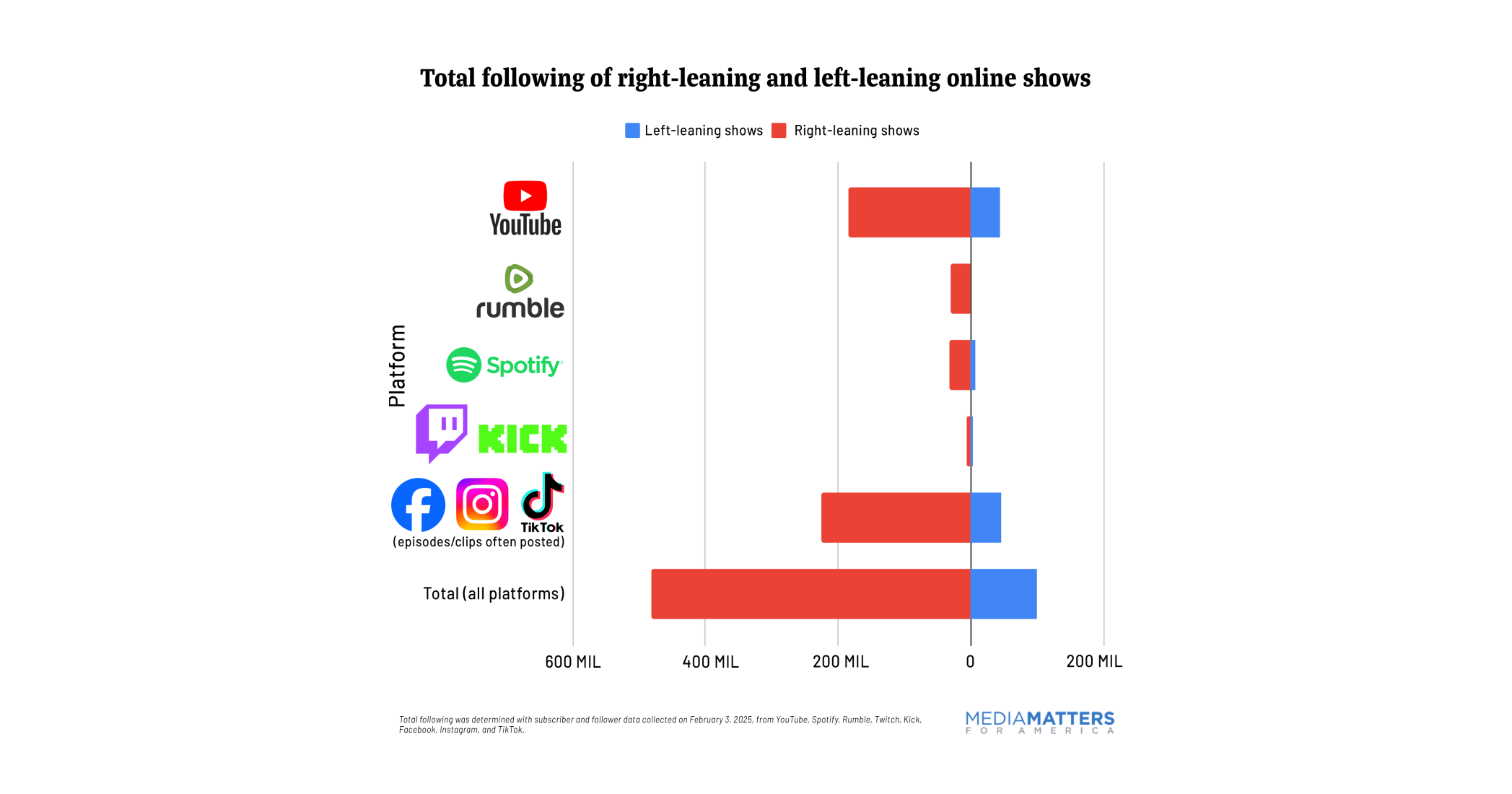
Still, reporting shows that conservative media dominates these spaces, often backed by well-funded networks and nonprofits.Here are some articles that help to outline this phenomenon:
“Right-Wing Megadonors Are Financing Media Operations to Promote Their Ideologies”
“Dark Money Donor Conduit Funneled $195 Million to Right-Wing Groups in 2024”
The result is that the online sphere is now dominated by right-leaning content.
So what now?
My recommendation for other observers is to remain open but stay vigilant. There are some very tough questions around foreign policy that we have to get our arms around.
A key problem is that the US amounts to 25% of the world’s consumption with less than 5% of the population. We don’t get there by promoting economic equality throughout the world. Today, we are affording our lifestyles based on cheap credit available to us because the US dollar is the world’s reserve currency, largely due to the defense spending in the Middle East to keep oil priced in dollars. Today, any countries who buy oil must have dollars on hand, keeping up demand for our currency even with public debt at 120% of GDP. The status quo is unsustainable.
Going forward, technology may ultimately play an important role in foreign policy. With renewables, battery technology, and nuclear power, energy is becoming a limitless technology that can be produced locally, rather than a finite, unevenly distributed commodity that is managed through geopolitics.
I believe the new world order will be impacted by advances in AI and robotics, bioengineering, and energy. Future geopolitics will be determined by the players that get all of this right. So far, it appears that the US and China are leading in this regard.
As this future emerges, we all just need to make sure that our internal divisions and internal politics don’t get in the way of making all of this successful, and this is why I remain so concerned about what’s happening domestically. To succeed as a country, people must have faith that systems can work and that communities can work together. This is where I have a real problem with the media from both sides with messaging aimed to divide the country and win elections.
As such, I strongly recommend being mindful of media consumption and propaganda from all sides. If anything, my observations on how I’m being hit by social media algorithms make me appreciate even more the need for us all to work together and to understand each other.