


Editor’s note
This post follows a town hall I attended last year with Rep. Suzanne Bonamici, which I wrote about here. I have also written about attending the first No Kings rally here and here.
With No Kings 3 coming up this Saturday, this felt like a good moment to connect those threads.
Coming back a year later
Last June, Marsha and I attended a town hall with Rep. Suzanne Bonamici. I came away from that evening feeling encouraged. The questions were serious but measured, and while there was frustration in the room, there was still a sense that institutions were strained yet recognizable.
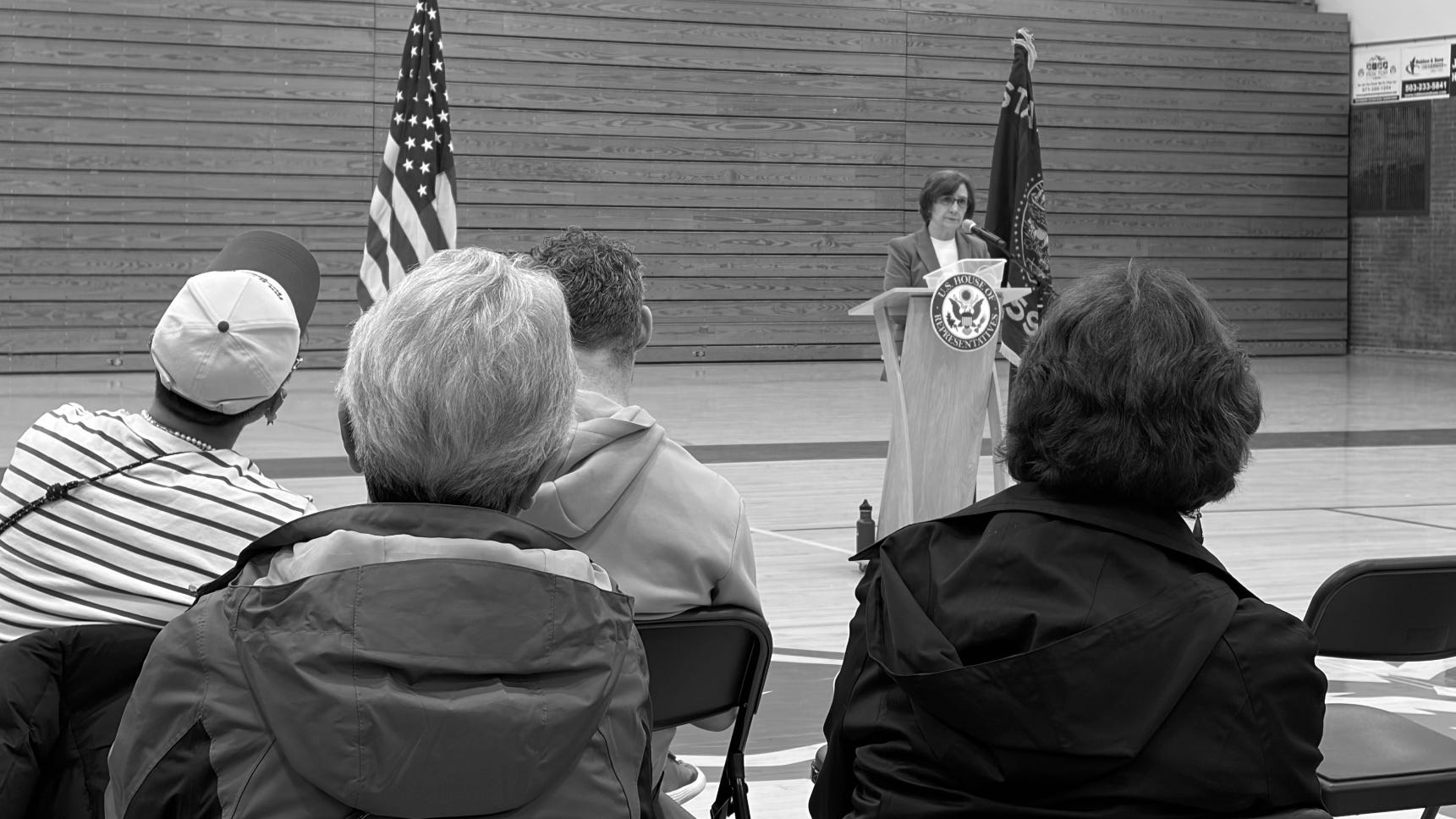
Last night’s town hall at Ida B. Wells High School felt different. It wasn’t worse, but it was heavier. It felt more urgent and less patient.
The format was familiar
The mechanics were what you would expect. Staff were present to handle constituent casework. Questions were handled by lottery. The session ran about an hour and ended on time.
Rep. Bonamici opened with remarks and then moved into a long Q&A with the audience.
From erosion to disregard
In my June 2025 post, I noted that Rep. Bonamici focused heavily on democratic norms, separation of powers, and civil liberties. She talked about political violence, illegal impoundment of funds, and the need to rely on the courts to check executive overreach.
Those themes were still present last night, but they felt sharper.
This time, the conversation was less about erosion and more about open disregard.
Bonamici described the last year and a half as “a time of chaos,” pointing to constitutional violations, corruption, and unilateral executive action. When she addressed the war with Iran, her framing was direct.
“The president does not have the authority to start a war. He didn’t come to Congress.”
Asking the question that was hanging there
One difference for me personally was that this time I got to ask a question.
I asked whether our current legal and congressional oversight mechanisms are actually sufficient to ensure accountability for executive abuses, or whether reforms are needed to prevent this from becoming the new normal.
Bonamici acknowledged that some reforms were put in place after the first Trump administration. She was also candid about the challenges. Oversight is harder when the Department of Justice is not acting independently, and enforcement gaps matter just as much as laws on the books.
Her answer echoed something that came up repeatedly throughout the night. Guardrails exist, but they only work if institutions are willing to use them.
A different tone from the audience
As the Q&A continued, a deeper frustration surfaced in the room.
Several people expressed some version of the same concern. This does not feel normal. Congress feels absent. Lawful process feels inadequate when the law itself is being ignored.
One person put it plainly. Business as usual does not feel like enough.
That sentiment came up again and again, even when the questions themselves were different.
Why protest came up so often
Bonamici did not push back on that frustration. Instead, she addressed it directly.
She made the case that public protest is not symbolic or optional in moments like this. It is a necessary response to authoritarian pressure.
“You know what authoritarians want you to do. Give up.”
Her argument was straightforward. Protest works because it resists that impulse. Being visible and persistent creates pressure that institutions alone cannot generate when those institutions are under strain.
That framing resonated with me. I have written before about showing up at demonstrations, including the first No Kings rally. At the time, those protests felt largely symbolic. Last night’s conversation made them feel more structural.
Things she has not done before
What stood out most to me was how explicitly Bonamici talked about crossing lines she had not crossed before as a member of Congress.
She described protesting outside federal agencies, including the Departments of Education and Labor. She talked about standing outside NOAA to oppose efforts to undermine the agency. She described skipping the State of the Union because she could not sit through what she viewed as repeated falsehoods.
She also emphasized the scale of her legal response. She has signed onto an unprecedented number of court briefs challenging the administration, using litigation when legislation stalls and enforcement fails.
These were not framed as symbolic gestures. They were described as reluctant but necessary steps.
Immigration and ICE
Immigration came up repeatedly during the evening.
In particular, Bonamici was asked about ICE activity at airports. Her response was unequivocal.
“ICE does not belong in airports.”
Her concern focused on safety, training, and mission creep. Airports require calm, specialized coordination. Introducing ICE enforcement into that environment increases fear and risk rather than security.
Voting rights and the SAVE Act
Separately, Bonamici spoke at length about the SAVE Act, which she described as a voter suppression bill.
Her concerns centered on the false premise that undocumented immigrants are voting and the real impact the bill would have on eligible voters. She emphasized the burden it would place on women, survivors of domestic violence, rural residents, and people without access to original documents.
Her assessment was blunt.
“He’s not going to win unless he suppresses the vote.”
At this point, the debate is no longer about intent. It is about consequences.
My take this time
Last year, I left the town hall thinking the system was under stress but still recognizable. This time, it felt like people were coming to terms with what it means when those systems no longer reliably protect us.
I am still glad Rep. Bonamici shows up, takes unscripted questions, and is honest about what she can and cannot do. I am also struck by how much of the evening focused on what citizens are expected to do next, not just what Congress might do later.
That shift matters, especially as we head into No Kings 3 this Saturday.
I have written before about the 3.5 percent rule. Erica Chenoweth’s research suggests that nonviolent campaigns are much more likely to succeed than violent ones, and that sustained participation from a relatively small share of the population can force serious political change. That does not mean everyone has to march, or even that everyone has to protest in the same way. It does mean that participation matters, whether that looks like watching from the street, supporting organizations doing the work, talking with people in your own circles, or simply staying engaged rather than tuning out.
If you are looking for a local No Kings event, the organizers list them at:
It also reinforces something I have written before. You can pretend to care, but you cannot pretend to show up.
AI disclosure: I used AI tools during the drafting and editing process to help clarify structure and language. All ideas, judgments, and final wording are my own.